Is Debt Consolidation a Good Idea? Why Consolidated Debt Is Still Debt
Debt consolidation can shrink your monthly payment, but it rarely shrinks your debt. The lower payment usually comes from a longer term, so you often pay more, and if your habits don't change the balances come back. Consolidated debt is still debt. In the Debt BLITZ, consolidation only comes after the plan is running. The Debt BLITZ is The Wealth Chef's get-out-of-debt method from my Break Free Forever book: Bring it into the light, Lock the leaks, Identify your target, Turbocharge the fuel, Zero it and roll. The debt snowball is used inside it.
Updated October 2026
This guide is part of my complete guide to getting out of debt and staying out.
African buffalo are considered the most dangerous animals in the bush, and they're often called "bank managers". When they stare at you with those soulless eyes, it's just like facing the bank manager to discuss your outstanding loans.
I'm sure you've seen the adverts. "Consolidate your debt. Just one smaller payment each month. Let us help you!"
"Let us make money off you" is more like it.
What is debt consolidation?
Debt consolidation means taking out one new loan or card to pay off several existing debts, so you're left with one payment instead of many. It changes who you owe and how you pay. It doesn't change how much you owe.
| Type | How it works | The catch |
|---|---|---|
| Unsecured consolidation loan | A personal loan pays off your cards, overdraft and store accounts | A lower payment often means a longer term The emptied cards are still open |
| Balance transfer card | Card balances move to a new card with a low or 0% promotional rate | A transfer fee The rate jumps when the promotion ends |
| Secured loan or remortgage | Your home is used as security for the new borrowing | Short-term debt becomes long-term debt Your home is at risk if you can't keep up |
The adverts sell the first column. Your future self pays for the third.
Why a lower payment can cost you more
A consolidation loan usually lowers your monthly payment by spreading the debt over more years, not by making it cheaper. Even at a lower interest rate, more years of interest can mean you pay back more in total.
Here's a worked example. It works the same in pounds, dollars, euros or rand. Say you have 45,000 of unsecured debt: a three-year loan of 15,000 at 14% and a four-year loan of 30,000 at 10%. Your payments are 512.66 and 760.88, a total of about 1,274 a month. By the end, you'll have paid 9,978 in interest.
Then the consolidation company calls. "Great news! We've lowered your payment to 724 a month and your rate to 9%." What they don't mention is that it now takes seven years.
| The same 45,000 | Payment and time | Interest and total |
|---|---|---|
| Keep the original two loans | About 1,274 a month Clear in 3 to 4 years | 9,978 interest 54,978 in total |
| Consolidate at 9% over 7 years | About 724 a month Clear in 7 years | 15,817 interest 60,817 in total |
| Consolidate at 9%, but keep paying 1,274 | About 1,274 a month Clear in about 3 years 5 months | About 7,478 interest About 52,478 in total |
The "lower payment" deal costs 5,839 more, before any fees. That's another six grand out of your pocket and three more years in debt.
Now look at the last row. The lower rate only helps if you refuse the lower payment and keep paying what you paid before. That takes a plan, not a new loan.
It's the Minimum Payment Trap in a smarter suit
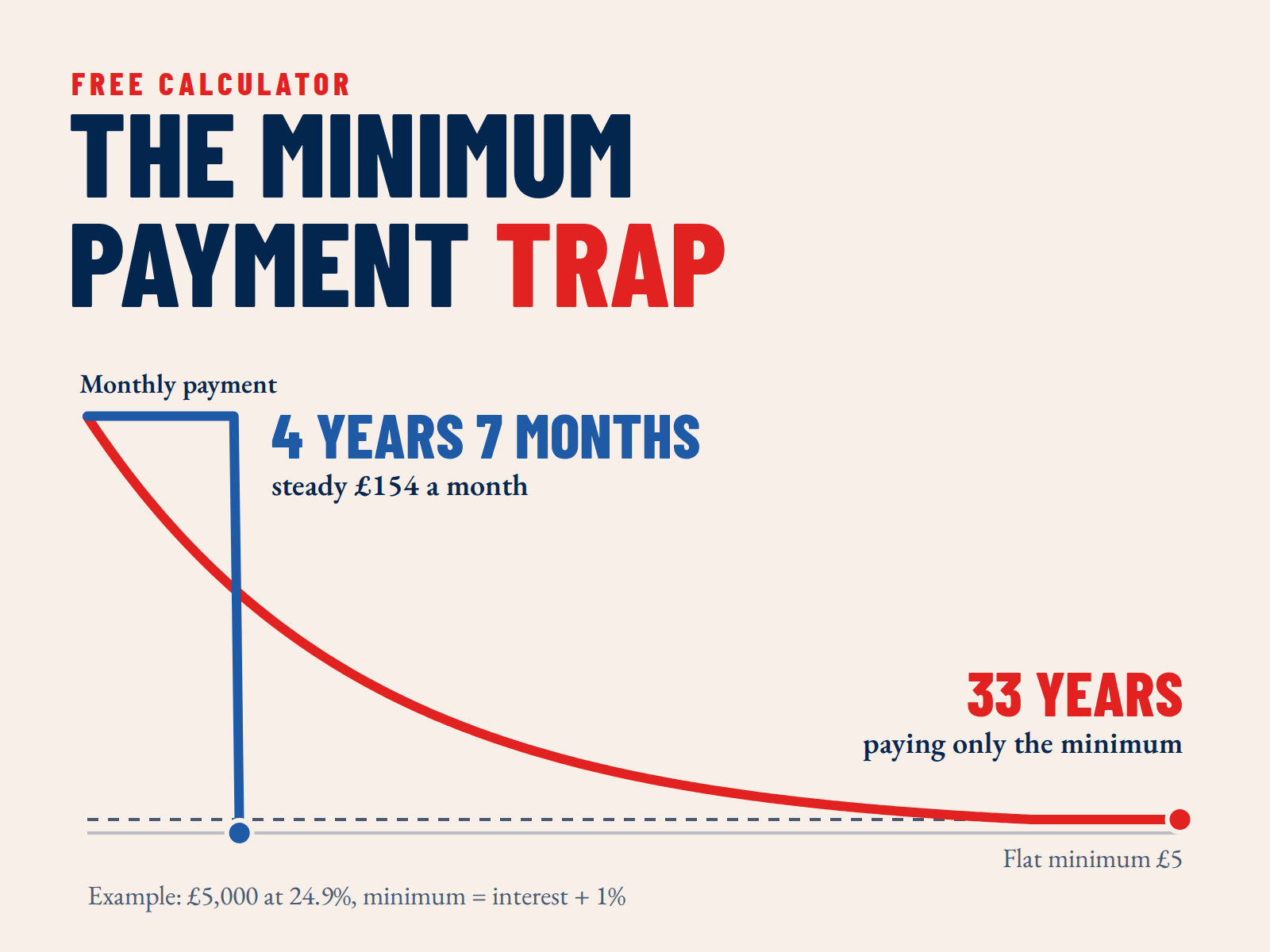
A shrinking payment is how lenders keep you paying for longer. The Minimum Payment Trap works the same way: minimum payments are set as a small slice of what you owe, so they shrink as your balance shrinks and barely reduce the debt. On a £3,000 card at 21%, the first minimum of about £82 includes about £52 of interest, so only about £30 comes off the debt. Read more in The Minimum Payment Trap: how long it really takes to pay off a credit card.
Before you sign anything, put one of your cards, store accounts or loans into my free calculator and see what a smaller payment really costs you.
Try the free Minimum Payment Trap calculator
Why consolidated debt so often comes back
Consolidated debt comes back because consolidation changes the balance, not the behaviour that built it. The cards are empty, the pressure is off, and the old habits find a new outlet.
In a 2023 TransUnion study of US borrowers, people who used a personal loan to pay off their cards saw card balances fall by an average of 57%. But for many of them, those balances were back close to their previous levels 18 months later. Median card utilisation dropped from 59% to 14% straight after the loan, then climbed back to 42% within 18 months.
Debt consolidation is like tidying your home by sweeping everything under the bed. The stuff is still there, draining money from your life. And seeing all that nice clear space, you go off and get more stuff to fill it.
"If you find yourself in a hole, stop digging." You can't get out of a debt hole by digging out the bottom. You have to stop the habits and behaviours that created the hole in the first place.
When can debt consolidation make sense?
Debt consolidation can make sense only after you've stopped borrowing, built a plan and changed your habits, and only if it lowers the total cost rather than only the monthly payment. Done from panic, it relieves pressure. Done from a plan, it can be a tool.
In the Break Free Forever book I'm clear that promotional deals, like a 0% balance transfer, can be used strategically in a BLITZ plan, but only if you have a clear plan to pay off the balance before the promotional period ends and the rate jumps. The same thinking applies to any consolidation offer. Ask these five questions first.
| Ask yourself | Why it matters |
|---|---|
| 1. Have I stopped all new borrowing? | If the old cards fill up again, you end up with the new loan and the old debt |
| 2. Is the total cost lower? | Compare the total you'll repay, fees included, not the monthly payment |
| 3. Will I keep paying what I pay now? | A lower rate only speeds you up if you don't pocket the lower payment |
| 4. Is my home being used as security? | Turning card debt into a secured debt puts your home on the line |
| 5. Do I know the end date of any promotion? | Write it on your Debt Truth Inventory and plan to clear the balance before it |
What works instead: a plan you stick to
What works is facing every debt, stopping new borrowing and paying one debt off at a time while you change the habits behind it. That's the Debt BLITZ, and it doesn't need a new lender.
It starts with a Debt Truth Inventory: a list of every debt you owe with eight facts for each: balance, interest rate, minimum payment, term, special conditions, what you actually pay, why you took it on, and its emotional weight. Here's how to do your Debt Truth Inventory.
It means seeing the three real costs of any debt: the price of what you bought, the interest you pay, and the lost opportunity of what that money could have built.
And it rests on one non-negotiable rule from the book: no new consumer debt while your BLITZ is running. As I put it there, the BLITZ plan is a bucket-bailing operation. It only works if no new water is being poured in while you bail.
Here's the Debt BLITZ Method step by step.
Getting out of debt, staying out and starting to build wealth isn't quick or easy. But it isn't complicated either. It can be done if you're prepared to deal with the habits and change the way you treat money.
Consolidation, debt management and debt review where you live
Free, independent debt advice is the place to start before you consolidate. Here's what official sources say about the risks.
| Where you live | What to know |
|---|---|
| UK | National Debtline warns that some consolidation loans take longer to repay than your original debt, making them more expensive, and that a loan secured on your home puts it at risk. Read National Debtline's guide to debt consolidation. |
| US | The CFPB notes that a lower payment may mean a longer term, that balance transfer rates are temporary and carry fees, and that a non-profit credit counsellor can help for free. Read the CFPB's guide to consolidating card debt. |
| South Africa | Debt counselling (debt review) under the National Credit Act isn't a loan. It doesn't cancel debt, the repayment period may get longer, you can't take new credit until you have a clearance certificate, and it isn't free. Read the National Credit Regulator's explanation. |
Not sure how serious your situation is? Here's how to know when debt is unmanageable.
Questions people ask
Does debt consolidation hurt your credit score?
It can. National Debtline notes that every loan application leaves a search on your credit file, and many searches can make borrowing harder or more expensive.
Is a balance transfer better than a consolidation loan?
A 0% balance transfer can cost less, but only for as long as the promotion lasts, and there's usually a transfer fee. It only helps if you have a plan to clear the balance before the rate jumps.
Build a real debt plan, not a new loan
Rolling your debts into one loan doesn't clear a penny of them. A plan you stick to does. ZARA is my free AI debt assistant. She builds your Debt Truth Inventory, sets your BLITZ order and freedom date, and shows what each extra pound a month buys. Save your plan with your email at the end.

Build your BLITZ plan free with ZARA
Want the whole method, from facing what you owe to changing the habits behind it and staying out for good? That's what the Break Free Forever book is for. Please don't fall for the debt consolidation hype.
If you're in serious financial difficulty, you don't have to work it out alone. Free, confidential help is available from StepChange, MoneyHelper or National Debtline in the UK, an NFCC-member non-profit credit counsellor in the US, or an NCR-registered debt counsellor in South Africa.
This article is for education only and isn't financial advice.
Written by Ann Wilson, founder of The Wealth Chef and author of The Wealth Chef and Break Free Forever. Debt-free since 1994 and financially free since 2006.