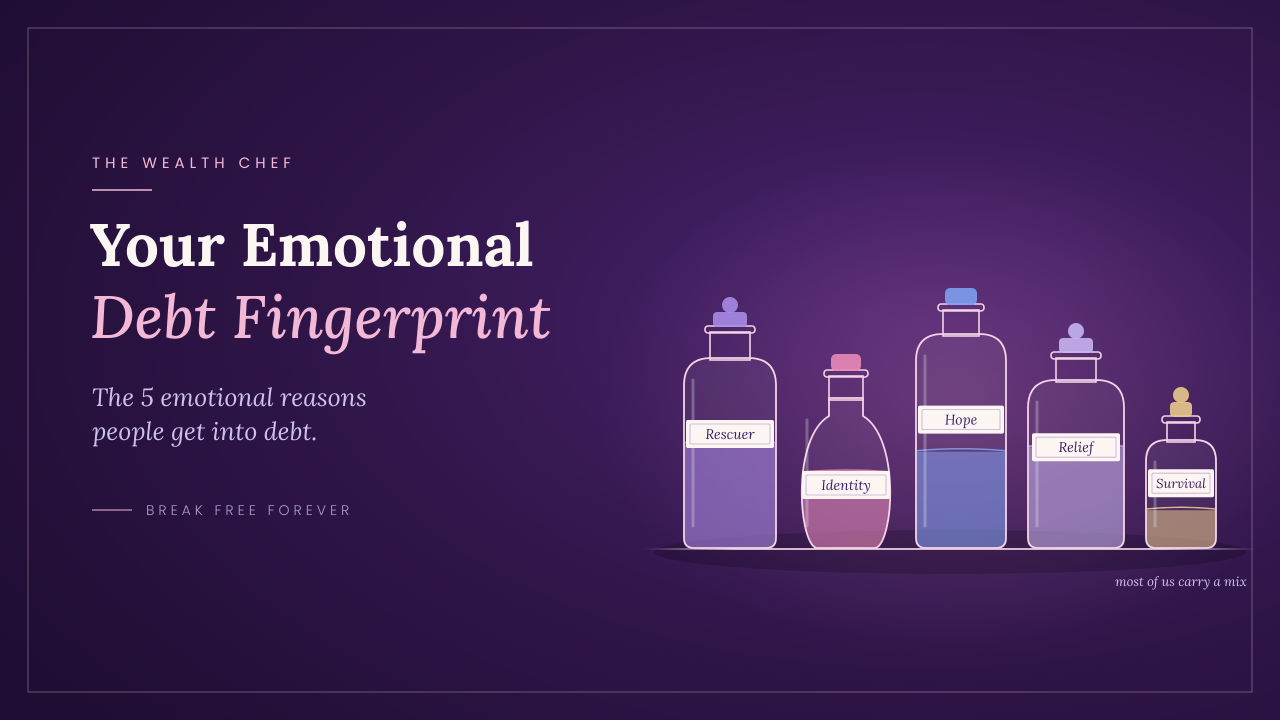
Your Emotional Debt Fingerprint: The 5 Emotional Reasons People Get Into Debt
People get into debt for five emotional reasons: to rescue someone, to protect an image, to fund a hope, to feel better, or to survive a crisis. Your Emotional Debt Fingerprint is your personal mix of the five emotional origins of debt: Rescuer, Identity, Hope, Relief and Survival debt. It comes from my Break Free Forever book. Your balance tells you what you owe. Your fingerprint tells you why, and the why decides what has to change so the debt doesn't come back.
This guide is part of my complete guide to getting out of debt and staying out.
In 1993 I was slipping toilet paper into my bag at work. I also owned a red plastic kayak, "bought on a bank overdraft, obviously, because that's what successful people do, isn't it?" Looking back, that kayak was a prop for the successful life I'd been performing. I didn't have a money problem. I had a money pattern problem.
Why do people really get into debt?
People get into debt through a mix of circumstance, culture and emotion, and the emotion is the part most advice skips. Two people can owe exactly the same amount and need completely different things to get free.
Debt is also far more common, and far more hidden, than it feels from the inside. In a 2026 poll of 4,000 UK adults for StepChange, 51% had experienced problem debt and 44% of them told no one. Two in five said debt made them feel ashamed. In South Africa, Sanlam's 2026 Budget Truths Survey found 10% of people felt caught in a debt or borrowing trap.
That silence matters, because shame makes you look away and debt keeps growing while you do. So look with curiosity instead. The #WTF practice is "Wow, that's fascinating": meeting your money patterns with curiosity instead of shame.
What are the 5 emotional reasons people get into debt?
The five emotional origins of debt are Rescuer, Identity, Hope, Relief and Survival debt. Most people carry a combination.
| Debt origin | What it looks like | The belief underneath |
|---|---|---|
| Rescuer Debt | Lending out of duty, covering someone else's rent or crisis, saying yes when your bank account says no | "My worth depends on being useful." |
| Identity Debt | The car, the school, the holidays, the hair: keeping up a life that looks the way it's supposed to look | "If I keep this up, I'll finally feel like enough." |
| Hope Debt | Courses, qualifications, coaching and business ventures financed without a grounded plan | "This one will finally change everything." |
| Relief Debt | The "I earned it" splurge, the late-night online order, the spend that comforts, numbs or distracts | "I need this to feel okay right now." |
| Survival Debt | Borrowing through job loss, illness, separation or bereavement, when life simply costs more than your income | "I should have coped better." |
Look at what sits under the top four. It's the Enough Gap: the belief that you are not enough, which drives spending to fill the gap. The Enough Gap is the seed, and these origins are how it grows.
Survival Debt is different. It's created by circumstance, which is why it carries the most unjust shame. StepChange reports that unemployment or redundancy (15%) and illness or injury (10%) are among the leading causes of debt for its clients, while few members of the public name them.
How do you find your Emotional Debt Fingerprint?
You find your fingerprint by going through your debts one at a time and naming the emotional story behind each one. Nobody's looking over your shoulder.
- Start with your list. Your Debt Truth Inventory is a list of every debt you owe with eight facts for each: balance, interest rate, minimum payment, term, special conditions, what you actually pay, why you took it on, and its emotional weight. Here's how to do your Debt Truth Inventory.
- Give each debt a primary origin. Add a secondary origin if one fits.
- Write its story in one sentence. What was going on when you took it on?
- Note what it still triggers. Shame, anger, regret, fear, or nothing at all.
- Step back. Which origin dominates? Is the same story repeating in different forms?
Here's a made-up example to show the format. These debts aren't a real person's.
| Debt | Origin | The story in one sentence |
|---|---|---|
| Credit card | Primary: Relief Secondary: Identity |
"Every hard month at work ended with a treat I couldn't afford." |
| Overdraft | Primary: Rescuer | "I covered my brother's rent twice and never asked for it back." |
| Personal loan | Primary: Hope | "I borrowed for a course that was going to change my career." |
What if every origin sounds like you?
If all five feel familiar, you're in good company. Most consumer debt isn't one-dimensional, and you don't need to untangle all of it before you start. As I say in the book: "Not perfect insight. Just honest looking."
What does each debt origin need?
Each origin needs a different response, which is why generic debt advice so often fails. A budget can't fix a boundary problem.
The numbers side is the same for all five. The Debt BLITZ is The Wealth Chef's get-out-of-debt method from my Break Free Forever book: Bring it into the light, Lock the leaks, Identify your target, Turbocharge the fuel, Zero it and roll. The debt snowball is used inside it. What differs is the work alongside it.
Rescuer Debt needs boundaries
Rescuer Debt usually comes from sincere love. Without boundaries, new rescuing keeps undoing your progress. Start with why lending to friends or family goes wrong. If you're carrying family obligations, read my conversation about black tax and the sandwich generation.
Identity Debt needs an honest look at what you value
The work is separating what matters to you from what you've been performing. When I sold the kayak, sold a car and took public transport, I found that the opinions I'd been so anxious about had no real bearing on my actual life. Phumulela and Ntobeko, caught in the "this is what success looks like" trap, found themselves in a R2.8 million debt hole. They chose their lives over the opinions of others and cleared R1.8 million in one year.
Hope Debt needs discernment
Hope isn't the problem. Debt-funded hope without a grounded plan is. Sam financed a series of training programmes on credit cards to start a coaching business, and found everything she earned going to service the interest. Trapped, as the book says, "not because she was reckless, but because she was hopeful and uninformed." She climbed out of a £25,000 hole with her BLITZ, and her business flourished.
Relief Debt needs new ways to feel better
Relief Debt isn't about being shallow. It's about being human under pressure, without enough tools for managing that pressure. Spending gives a quick lift, then it fades and the bill arrives. What a depleted body needs is real rest, connection and care. The #WTF practice helps you pause between the feeling and the spend.
Survival Debt needs compassion and a buffer
Keep two jobs separate here. The compassion work is releasing shame that doesn't belong to you. The debt is evidence that you survived something hard, not evidence of failure. The practical work starts with your Emergency Pot: about £800, $1,000, €1,000 or R10,000 in a separate account, built before the BLITZ, so a surprise bill never sends you back to credit. Here's why you need an emergency fund.
How do you stop feeling ashamed of your debt?
You stop feeling ashamed by separating shame from responsibility, because they aren't the same thing. Taking responsibility moves you forward. Shame adds self-punishment to a financial obligation, and you carry both indefinitely.
Almost everyone has one debt they feel particularly bad about. Responsibility looks like acknowledging the decision, understanding what drove it, and committing to clear it. The debt needs to be paid. The shame can be released.
That emotional weight is also useful. The BLITZ hybrid method means choosing which debt to clear first by scoring each on interest rate (weighted highest), balance size and emotional weight. It combines the avalanche and the snowball. So the debt that makes your stomach drop can earn its way up your list. Here's how the scoring works.
What if you can't even look at your debts?
The five origins tell you where a debt came from. Avoidance is what you do once it exists, and it's a self-protection strategy, often in people who are highly capable everywhere else. What helps is a structured, undramatic way to keep looking. A Money Date is a regular appointment with your money, weekly, monthly, quarterly and yearly. A date, not a meeting.
Some of these patterns run deep. If what comes up feels bigger than a blog post can hold, a therapist or counsellor can help alongside your plan, and Mental Health UK's guidance on debt and shame is a kind place to start.
Questions people ask
Why do I keep getting into debt?
Usually because the balance changed and the pattern didn't. If you clear a debt without understanding its origin, the same feeling finds a new outlet later. Here's how to stay out of debt for good.
Can emotional spending cause debt?
Yes. That's Relief Debt, and it's common. In a Harris Poll for NerdWallet in 2016, 49% of US adults said emotions had caused them to spend more than they could reasonably afford, and stress was the top trigger.
Do I need to understand my debt before I start paying it off?
No. The Debt BLITZ works on the numbers whatever the origin. The emotional work runs alongside it, and it's what keeps you free afterwards.
See the whole picture, then make a plan
Coral put it perfectly: "For the first time ever, I understand why I couldn't stay debt free." ZARA gives you the plan to go with that understanding. She's my free AI debt assistant: she builds your Debt Truth Inventory, sets your BLITZ order and freedom date, and shows what each extra pound a month buys. Save your results with your email at the end.

Build your BLITZ plan free with ZARA
The full fingerprint exercise and the Debt BLITZ are both in the Break Free Forever book.
If you're in serious financial difficulty, you don't have to work it out alone. Free, confidential help is available from StepChange, MoneyHelper or National Debtline in the UK, an NFCC-member non-profit credit counsellor in the US, or an NCR-registered debt counsellor in South Africa.
This article is for education only and isn't financial advice.
Written by Ann Wilson, founder of The Wealth Chef and author of The Wealth Chef and Break Free Forever. Debt-free since 1994 and financially free since 2006.