How to Stay Out of Debt for Good
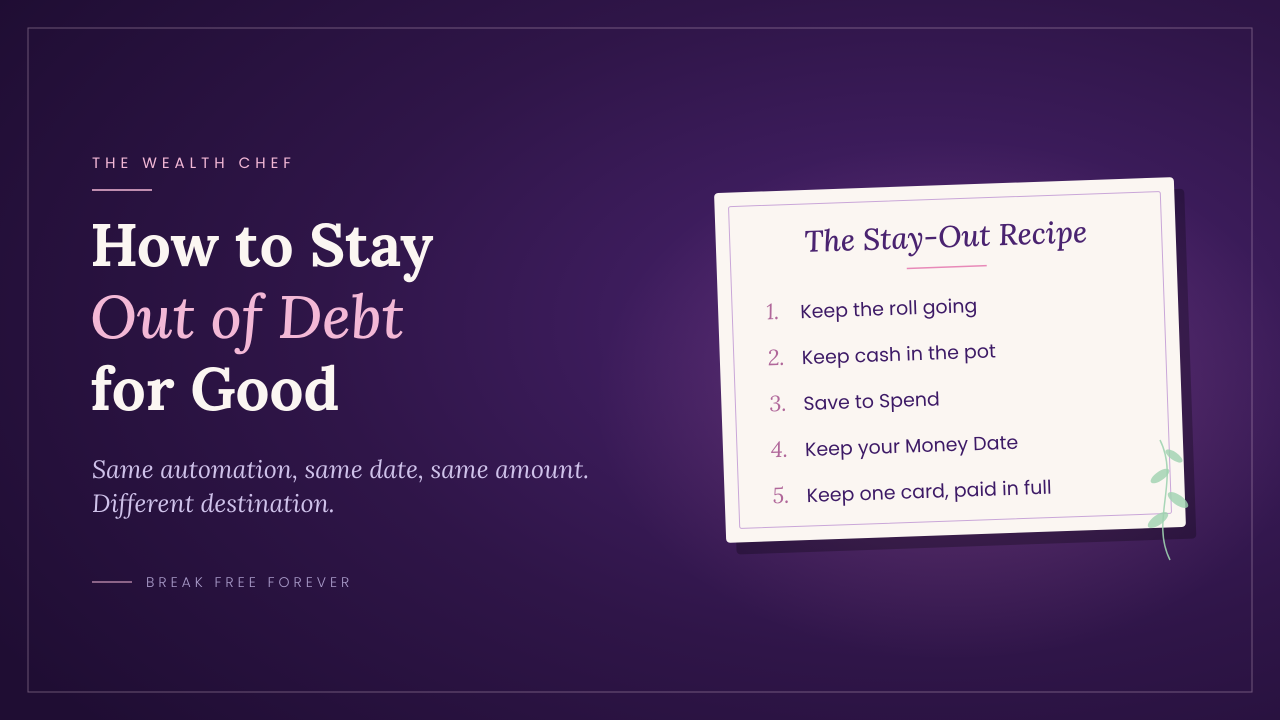
To stay out of debt for good, you have to replace the system that cleared it. Most people who slide back don't make one big mistake. The last debt goes, nothing takes the plan's place, and the old patterns find a new outlet. In the Break Free Forever book I call this the Backslide. The way to avoid it is to decide where your monthly debt payment goes next, before the last debt clears: same automation, same date, same amount, different destination.
This guide is part of my complete guide to getting out of debt and staying out.
I've been debt-free for over three decades, and getting out is only half the job. Staying out is a project of its own.
Why do people go back into debt after paying it off?
People go back into debt because they changed the balance without changing what built it. The debt came off, but the habits, the emotions and the easy access to credit all stayed where they were.
It happens far more often than anyone admits. When TransUnion followed people in the US who used personal loans to clear their credit cards, card balances fell by 57% on average, and for many they returned close to their previous levels 18 months later. Those people weren't weak or stupid. They had moved the debt rather than cleared it, but the lesson holds either way.
Two things usually drive the Backslide:
- The money has no job. The day the last debt hits zero, there's suddenly £200, $400 or R6,000 a month with nowhere to go. For a month or two it feels incredible. Then a subscription creeps back, your lifestyle expands, and the money is gone.
- The pattern is still there. Your Emotional Debt Fingerprint, your personal mix of the five emotional origins of debt: Rescuer, Identity, Hope, Relief and Survival debt, doesn't vanish with the balance. It waits for a new outlet.
Coral put it perfectly: "For the first time ever, I understand why I couldn't stay debt free." Understanding why is where staying out begins.
How do you stop the money disappearing once the debt is gone?
You stop it disappearing by giving your debt payment a new job before the last debt clears. I call this keeping the roll going, and it's the most useful decision you can make.
The Debt BLITZ is The Wealth Chef's get-out-of-debt method from my Break Free Forever book: Bring it into the light, Lock the leaks, Identify your target, Turbocharge the fuel, Zero it and roll. The debt snowball is used inside it. Every time a debt falls, its payment rolls onto the next one. Staying out means one more roll, with your own future as the target.
| Your payment | During your BLITZ | After your BLITZ |
|---|---|---|
| Date | Payday | Payday |
| Amount | Everything you were paying | The same amount |
| How | Automatic | Automatic |
| Destination | Your target debt | Your wealth |
Samantha is doing exactly this. "Since I started my debt free journey, my £4k overdraft and two credit cards have been wiped out, and by the end of the year I'll have paid off a further £14k and be debt free," she says. "Once my cards are cleared, I'm putting all the money I was using for debt repayment straight into investing. I'm now on track to be financially free and able to retire before I'm 60, if I choose to."
Here's what's at stake. In the book's example, £200 a month invested at an assumed 10% a year grows to about £41,000 after 10 years, £152,000 after 20 and £452,000 after 30. That's an illustration, not a promise, but it's the same £200 that could otherwise drift away.
It helps to know what you're rolling towards. Your Break Free Number is the point where your assets can replace your current income and working becomes a choice based on what your target "enough" life contains. It's sized with the 8% drawdown rate: the yearly cost of that "enough" life divided by 8%, which is 12.5 times the yearly cost. WILLOW helps you design your wealthy life and find yours.

Find your Break Free Number free with WILLOW
You don't need to know how to invest yet to make this decision. That's a separate skill, and The Wealth Chef book picks up exactly here.
What keeps you out of debt when willpower runs out?
A system keeps you out of debt when willpower runs out. Each part of it guards against one specific way people slide back.
| What pulls you back | Your guard |
|---|---|
| A surprise bill | Emergency Pot, growing into your Cash Safety Net |
| A cost you knew was coming | Save to Spend |
| Lifestyle creep | Wealth Leak Audit |
| Slow drift back to old habits | Money Date |
| Easy credit | No More Declaration |
Keep cash between you and the card
Your Emergency Pot is about £800, $1,000, €1,000 or R10,000 in a separate account, built before the BLITZ, so a surprise bill never sends you back to credit. It grows into your Cash Safety Net, the cash buffer that makes an emergency an inconvenience, not a crisis. I teach three to nine months of your basic and essential living costs, depending on how steady your income is and who relies on it. Here's why you need an emergency fund.
Turn known costs into monthly ones
Christmas, car services and annual bills aren't emergencies. Save to Spend means adding up the costs you know are coming in the next 12 months, dividing by 12, and setting that amount aside every month.
Check for leaks when life changes
A Wealth Leak Audit is a check of six places money leaks out without you choosing it: convenience spending, subscriptions, lifestyle creep, emotional spending, social and obligation spending, and bank fees. Here's how to run one. Any pay rise is a good moment to repeat it.
Keep your Money Date
A Money Date is a regular appointment with your money, weekly, monthly, quarterly and yearly. A date, not a meeting. It catches drift before it becomes derailment.
Keep your declaration where you can see it
The book's No More Declaration includes this line: "I will never again use consumer debt for any reason. Not while my BLITZ is happening. Not after it's done." It takes a whole category of decisions away from the moments you're least equipped to make them.
Should you close your credit cards once you're debt-free?
What I teach is to close the extras once you're clear and keep one card, used consciously and paid in full every month. The timing matters, because a card closed too early can raise your credit utilisation, the share of your available credit you're using.
While your BLITZ is running, a just-paid card can stay open at zero as a short-term holding position. Once your debt is clear and you've worked through the patterns that created it, the overdrafts, store cards and extra credit cards close one by one. The one you keep is a tool, never a backup plan for when the money runs out.
Elisha, who cleared about $13,000, shrank the temptation as she went. "Each month, after paying my credit card bill, I'd call in and reduce my available limit — so the space I'd cleared couldn't pull me back in," she says. Six years on, she's still debt free and investing regularly.
| Where you live | What to know |
|---|---|
| UK | Cancelling a card can raise your credit utilisation, and the effect depends on the lender. MoneySavingExpert suggests getting written confirmation of the closure and checking your credit reports a few months later. |
| US | The CFPB says closing a card can lower your score, though the change may be temporary or minor. |
| South Africa | You can get a free credit report from every bureau once a year, which lets you check that closed accounts show as closed. |
What should you do if an old pattern comes back?
If an old pattern comes back, treat it as information, not failure. Old patterns are well practised, so they get weaker and get caught faster, but they rarely disappear altogether.
- Notice without spiralling. "I knew I couldn't do this" is itself an old pattern.
- Get curious. The #WTF practice is "Wow, that's fascinating": meeting your money patterns with curiosity instead of shame. Even after the spend, asking what you were feeling turns guilt into information.
- Go back to the next payment. One slip doesn't need a reset or a new start date. Just let the next scheduled payment go through.
If you've already slid back into debt, you know more than you did last time. Start again with your Debt Truth Inventory: a list of every debt you owe with eight facts for each: balance, interest rate, minimum payment, term, special conditions, what you actually pay, why you took it on, and its emotional weight. Here's how to do it.
Questions people ask
Is it normal to go back into debt after paying it off?
Yes, it's very common, and it says nothing about your worth. It usually means nothing replaced the plan that got you out. Replace the system and you change the outcome.
Should I save or invest after paying off debt?
I teach building your Cash Safety Net alongside your BLITZ, so by the time the last debt goes you're well on your way. Whatever's left of it comes first, then your payment can roll towards investing.
Start with a plan you can see
Still clearing your debts? ZARA is my free AI debt assistant. She builds your Debt Truth Inventory, sets your BLITZ order and freedom date, and shows what each extra pound a month buys. Save your results with your email at the end.

Build your BLITZ plan free with ZARA
The whole journey, including what happens after your last payment, is in the Break Free Forever book.
If you're in serious financial difficulty, you don't have to work it out alone. Free, confidential help is available from StepChange, MoneyHelper or National Debtline in the UK, an NFCC-member non-profit credit counsellor in the US, or an NCR-registered debt counsellor in South Africa.
This article is for education only and isn't financial advice.
Written by Ann Wilson, founder of The Wealth Chef and author of The Wealth Chef and Break Free Forever. Debt-free since 1994 and financially free since 2006.