How Many Index Funds Do You Need? The 5-Tracker Core Portfolio
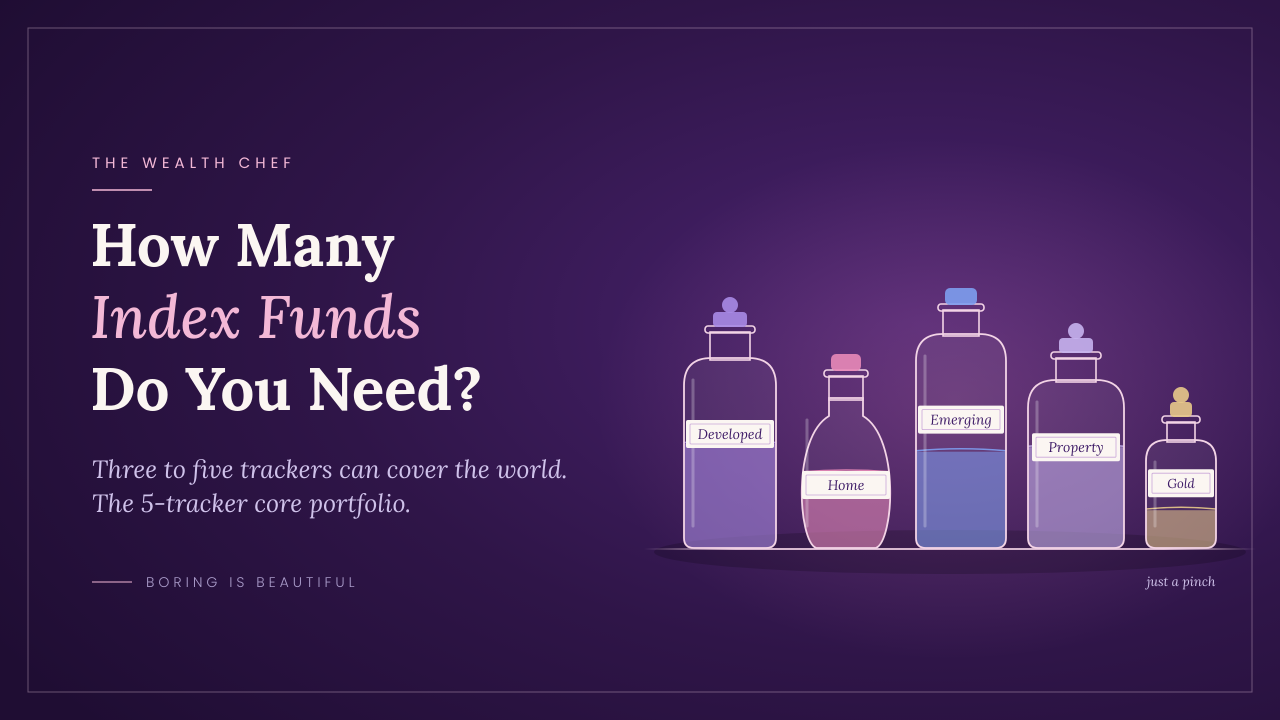
Most people need just three to five index funds. In my 5-tracker core portfolio, those are a developed markets tracker, a home market tracker, an emerging markets tracker, a global property tracker and, if you want one, a small chaos hedge such as gold. Together they give you thousands of companies across the world's economies. Where you live can bring it down to three or four, because your home market may already sit inside one of the others. Beyond five, you mostly buy the same companies again, pay more and make your investing harder to manage.
This guide is part of my complete guide to investing in index funds.
It's one of the questions I'm asked most, usually by people who suspect they have too many funds, or who can't believe three could be enough.
Why three to five index funds is enough
Three to five index trackers are enough because each one already holds hundreds or thousands of companies. A single world index tracker following the MSCI ACWI index held 2,414 companies across 23 developed and 24 emerging market countries at the end of September 2026. Adding more funds rarely adds more spread. It mostly adds the same companies twice.
Diversification comes from which funds you hold, not how many: spread across countries, currencies, industries and asset classes. As the UK regulator's InvestSmart guide to diversification explains, funds pool money from many investors, so even a small amount can be spread widely.
In The Wealth Chef book, in the recipe I call Expand Your Dough, I set the target at four or five trackers in your whole portfolio. That still holds. Boring is beautiful.
The 5-tracker core portfolio
The 5-tracker core portfolio covers past, present and future: developed markets are the past, your home market is the present, emerging markets are the future, and global property and a chaos hedge add two different asset classes on top. Each slice does a different job, which is why there's no point doubling up on any of them.
| Tracker | Its job in your portfolio |
|---|---|
| 1. Developed markets | The biggest, most established markets, mostly the US, plus Europe, the UK, Japan and Australasia. Usually your largest slice. |
| 2. Home market | Companies in the country where you live, earn and spend, in your own currency. |
| 3. Emerging markets | Faster-growing economies such as China, India, Taiwan, Brazil and South Africa. More ups and downs, and exposure to where growth is coming from. |
| 4. Global property | A tracker that owns real estate investment trusts (REITs) worldwide: offices, warehouses, shopping centres and hospitals. A second asset class, rather than more shares. |
| 5. Chaos hedge (optional) | A small sliver of physical gold. It doesn't grow or pay income. It's insurance that tends to hold its value when markets are frightened. |
You don't need all five. Many people run a perfectly good core on four, without the chaos hedge. If you hold gold, the guideline I teach is to keep it small: up to about 5% of the portfolio. Gold funds are usually exchange traded, so many people buy it as a lump sum and top it up once a year.
If this is your first time putting a portfolio together, start with how to design your investment portfolio. Design the portfolio first, then pick the funds to fill it. Never the other way round.
How many index funds you need where you live
Where you live decides whether you need three, four or five trackers, because your home market may already sit inside your developed or emerging markets fund. The rule is simple: don't double up.
| If you live in | Your core trackers | Typical count |
|---|---|---|
| The US | One US tracker covers home and most of developed Optional developed markets excluding the US Emerging markets Global property Optional gold |
3 to 5 |
| The UK, Europe, Canada or Australia | Home market (for example the FTSE All-Share in the UK) Developed markets or a US tracker Emerging markets Global property Optional gold |
4 to 5 |
| South Africa or another emerging market | Developed markets (one fund, or a US fund plus a rest-of-developed fund) Emerging markets, which already includes your home market Global property Optional gold |
3 to 5 |
| Abroad, away from where you grew up | Your home market is where you live, earn and spend now, then follow the row that fits that country | 3 to 5 |
A note for South Africa: Regulation 28 limits how much of a retirement annuity can be invested offshore, so a large part of yours is likely to sit in South African shares already. Look at your accounts together: your retirement annuity may cover your home and emerging slices, leaving your tax-free and discretionary money to go mostly into developed markets and global property.
When a South African member asked me how to split the money outside their retirement annuity, the illustration I gave was roughly 50% developed markets, 30% global property and 20% emerging markets. That's an example of the thinking, not a recipe for you. Your split depends on your goals, your timeline and what you already own.
What happens when you own too many index funds
Owning too many index funds doesn't spread your money further. It buys the same companies several times, makes it hard to know what you actually own, and turns every monthly investment into a puzzle about where each pound should go.
The double-up I see most is a world tracker plus an S&P 500 tracker plus a technology tracker. At the end of September 2026, the US made up 64.21% of the MSCI ACWI world index. So the world fund is already mostly American, the S&P 500 fund is entirely American, and the technology fund holds many of the same giant American companies again. Three funds, one bet.
One member who had moved their ISA away from a financial adviser found it still held 17 funds. With that many, you're almost certain to own the same companies over and over. Lots of funds can look impressive on a statement. That doesn't make it diversified.
Five signs you have too many funds
- Two or more of your funds track the same index, or the same country.
- You hold a world tracker and separate developed and emerging trackers, so your percentages no longer mean what you think.
- The same ten companies appear at the top of several fund fact sheets.
- You can't say, without a spreadsheet, roughly what share of your money is in developed markets, emerging markets and property.
How to check your funds for overlap
To check for overlap, read each fund's fact sheet, note what share sits in developed markets, emerging markets, property and the US, and add it up across your whole portfolio. I call this WISIWYG: what's inside is what you get. If the totals don't match the portfolio you designed, you have duplication.
- List every fund in every account: pension, tax-free and discretionary.
- Open each fund fact sheet and note the index it tracks, its country split, its top ten holdings and its ongoing charge.
- Add up your exposure to developed markets, emerging markets, property and gold across everything. A portfolio analysis tool, or an AI assistant given your fund list, can do the sums for you, but check its answers against the fact sheets.
- Compare it with your design. It doesn't need to be exact. It needs to be in the right ballpark.
- Simplify with care. Before you sell anything, check for exit fees and, outside tax-protected accounts, for tax on gains. Often the cheapest fix is to stop adding to the extra funds and point new money at your core trackers.
I do this once a year on my yearly Money Date. A Money Date is a regular appointment with your money, weekly, monthly, quarterly and yearly. A date, not a meeting.
Starting small: one fund first, then build
If you're starting with a small monthly amount, one world index tracker is a perfectly good first step. As your contributions grow, add the other slices one at a time until you have your full core portfolio. Starting now matters far more than starting perfectly.
Splitting a small amount too many ways can backfire. Exchange traded funds can charge a dealing fee on every purchase, which hurts more on tiny slices. Unit trust or mutual fund trackers often have no dealing fee. Here's the difference between ETFs and unit trusts or mutual funds.
A worked example
Say you invest £150 a month. This is an illustration, not a recommendation.
| Stage | What the £150 buys each month |
|---|---|
| Getting started | £150 into one world index tracker |
| Four-tracker core | £37.50 each into home, developed, emerging and global property |
| Five-tracker core | £30 each, or keep four monthly trackers and buy gold once a year as a lump sum |
The same thinking works for $150, €150 or R2,500. Check your platform's minimum for each fund before you split.
Do you need the same funds in every account?
No. Your portfolio is everything you own across your pension, tax-free account and discretionary account, so look at the percentages across all of them, not account by account. Where the rules let you, it's simplest to use the same recipe in each.
Sometimes the rules push different slices into different accounts, as with Regulation 28 in South Africa. That's fine, as long as the whole adds up to your design. My guide to understanding your different investment accounts explains the three account types.
Once your core is set, it runs on my KISSS core investing strategy: keep it simple, sexy and safe. A fixed monthly amount, split across your three to five trackers, set on autopilot, reviewed and increased once a year.
Questions people ask
Is one index fund enough?
One world index tracker is enough to start. Many people later add emerging markets and global property trackers, for a second asset class and more control over their percentages.
Should I hold an S&P 500 fund and a world fund?
Usually not both as separate slices, because the world fund is already mostly US companies. Choose either a world tracker or separate developed, home and emerging trackers, and design your percentages around that choice.
See how I build my own portfolio
If you'd like to see exactly how I design a core index tracker portfolio, choose the trackers and put it all on autopilot, join my free How to Be a Successful Investor masterclass. It's 90 minutes, and I walk you through the whole recipe.

Register for the free How to Become a Successful Investor masterclass
When you're ready to build yours with me, step by step, my Savvy Investor programme takes you from opening your platform to a fully designed, automated index tracker portfolio. You'll hear all about it in the masterclass.
This article is for education only and isn't financial advice.
Written by Ann Wilson, founder of The Wealth Chef and author of The Wealth Chef and Break Free Forever. Debt-free since 1994 and financially free since 2006.