The Complete Guide to Investing in Index Funds
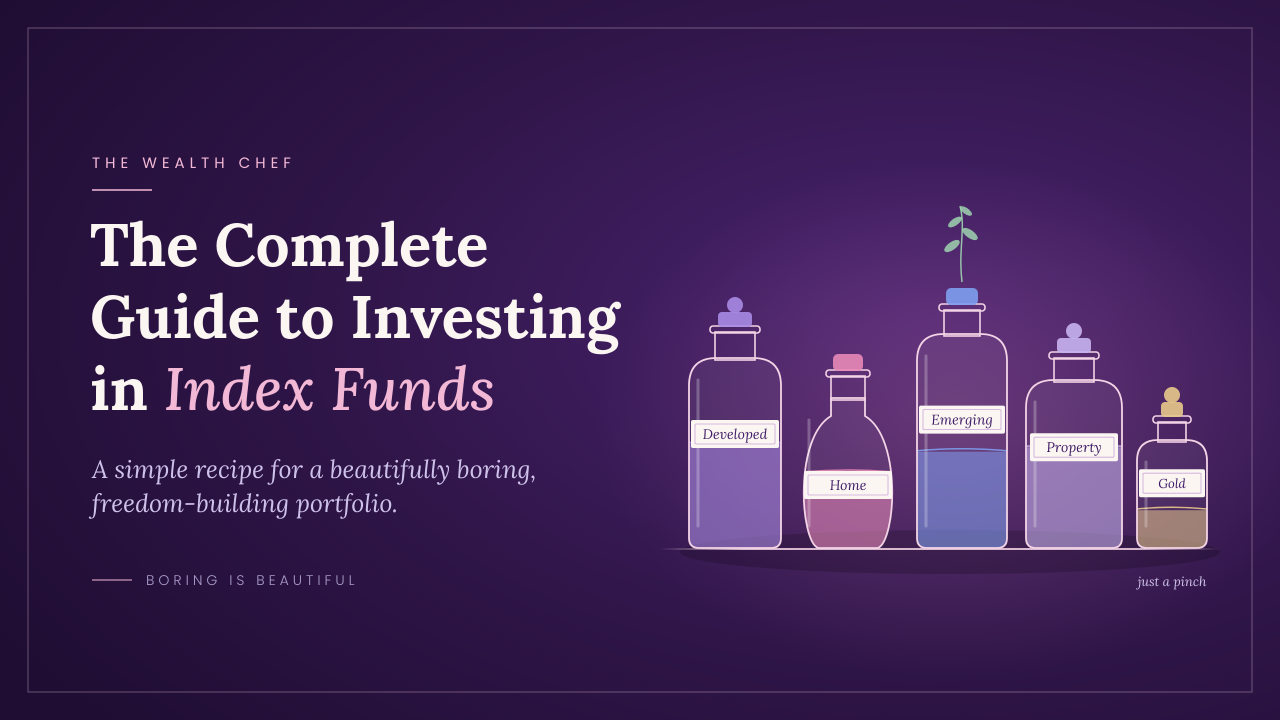
To invest in index funds, design a simple portfolio first, then open an online investment platform, fill your tax-free and tax-deferred accounts before anything else, choose three to five low-cost index trackers (developed markets, your home market, emerging markets, global property and an optional sliver of gold), and set up an automatic monthly investment into them.
Then leave it alone and let compounding do the work.
I call this my KISSS core investing strategy: keep it simple, sexy and safe.
It is far simpler than the financial industry wants you to believe.
I have been investing for over 28 years and I have been financially free since 2006. The engine room of that freedom is boring, regular index tracker investing.
In this guide I give you the whole recipe: what index funds are, why they beat most professional fund managers, how to design your core portfolio, which accounts to use, how to pick your funds, and how to keep going when markets wobble.
In this guide:
- What an index fund is
- Why you need equities working for you
- Why index funds beat most actively managed funds
- The 3 C's: the only things you can control
- Invest like an Egyptian: where index funds fit in your wealth
- How to design your core index tracker portfolio
- ETFs, unit trusts and mutual funds
- The three accounts to invest through
- How to choose an online investment platform
- How to choose your index funds
- The KISSS core investing strategy, step by step
- How to invest a lump sum
- Volatility, crashes and the three-year rule
- The six behaviours of successful investors
- How index funds build your Break Free Number
- Ethical index investing
- Questions people ask
- More guides on investing in index funds
What an index fund is
An index fund, which I call an index tracker, is a fund that buys every share in a stock market index, in the same proportions as the index, so you own a slice of hundreds or thousands of companies with a single investment. There is no fund manager picking shares. A computer simply mirrors the index.
An index is just a list. The S&P 500 lists the 500 biggest companies listed and sold on exchanges in the US. The FTSE All-Share lists the companies traded on the London Stock Exchange. A world index lists companies across the world's developed and emerging stock markets. When you buy one unit of a fund that tracks one of these lists, you own a tiny piece of every company on it.
Think of it as a hamper rather than a single jar from the deli. One purchase, a whole selection of good things inside.
Here's more on what an index tracker is and why you should care.
Why you need equities working for you
Every person building wealth needs equities, meaning shares in companies, because they are the easiest asset to own, the most liquid, the cheapest to buy and the one governments give you the most tax breaks to hold.
Owning shares makes you a business owner without having to turn up for a day's work.
When you own an equity, you get a share of a company's growth and a share of the profits it pays out as dividends. You don't manage staff, make decisions or answer emails. Many people dream of owning a business. Owning slices of extraordinary businesses all over the world is the simplest way to do it.
People often say they are "investing in the stock market". You aren't.
You invest through the stock market, which is simply the supermarket where shares are bought and sold. What you actually own are the companies. If equities still feel like a world for other people, start with stock market investing 101 and why you need stocks and shares.
Why index funds beat most actively managed funds
Index funds beat most actively managed funds because of two things: cost and churn. You get the market's return without paying a team of highly paid people to try, and usually fail, to beat it.
An actively managed fund employs fund managers to pick shares they believe will outperform. Those people, their bonuses, the fund house's marketing and the adviser who sold you the fund are all paid out of your money, every year. They also tend to buy and sell far more often than an index fund, and every trade has a cost.
The evidence is consistent.
S&P Dow Jones Indices, which has tracked this for 25 years in its SPIVA reports, found that 79% of active large-cap US equity funds underperformed the S&P 500 in 2025. Picking the few that will beat the market, year after year, is close to impossible.
This is exactly what John Bogle found when he challenged the fund industry's assumptions. In 1976 he launched the first index fund for ordinary investors, First Index Investment Trust, now the Vanguard 500 Index Fund.
There is one more reason I love index trackers: they automatically give you the cream of the crop.
When a company or a whole industry starts to fade, it drops out of the index. When a new one rises, it comes in. You never have to guess whether horse-drawn carts or motor cars are the future. The index decides for you.
Read more on how index tracking gets you more from your money and why Warren Buffett recommends index funds.
The 3 C's: the only things you can control
You can't control the markets, but you can control three things that decide most of your investing success: your costs, your consistency and your contributions. I call them the 3 C's of investing success. Put your energy here and let the rest go.
| The C | What it means for you |
|---|---|
| Cost | Keep the total cost of your investing (fund charges, platform fees and trading costs together) well under 1% a year. Costs come off before your money gets to grow. |
| Consistency | Invest every month, no matter what the headlines say. A good strategy consistently applied beats a brilliant strategy applied now and then. Automate it so it doesn't depend on willpower. |
| Contributions | Compounding needs a seed. The more you pay yourself first, and the earlier you start, the more assets you own and the sooner you're free. |
What costs do to your money: a worked example
Here is an illustration, not a forecast. Imagine your investments grow by 7% a year before costs, over 25 years. The only difference between the two columns is the yearly cost.
| After 25 years | Index tracker, 0.2% cost a year | Active fund plus adviser, 2% cost a year |
|---|---|---|
| £10,000 invested once | About £51,800 | About £33,900 |
| £200 invested every month | About £152,900 | About £117,600 |
Same money in, same markets, same risk. Tens of thousands of pounds, dollars, euros or rand simply go to someone else - when it should stay in your pocket. That's why I say get ferocious about costs. The compounding behind this is explained in understanding compound interest and why you need it working for you.
Invest like an Egyptian: where index funds fit in your wealth
Index trackers form the broad, boring base of your wealth pyramid, and the base is what everything else rests on. I call this investing like an Egyptian, because a pyramid is the most stable structure there is.
Your wealth pyramid has four sides: you (your ability to earn and manage money), intangible assets like shares, tangible assets like property, and, if you choose, low-input businesses.
A four-sided pyramid stands firm and solid - no matter what life throws at it. A pogo stick, where your only asset is your job, falls over the moment you stop bouncing.
On the equity side, the wide base is regular investing in broad index trackers. Only once the base is solid do you add anything more speculative at the top. If you start at the top, you've built a pyramid on sky hooks, and the first strong wind brings it down.
Portfolios create wealth, never single investments.
In my portfolio design, equities can make up as much as 70% of your investments, because they are the easiest, most liquid and most tax-efficient asset class. Many people start with 100% in index trackers and add property and other assets as their wealth grows. Here's how to design your investment portfolio.
How to design your core index tracker portfolio
A well-diversified core portfolio needs just three to five index trackers: developed markets, your home market, emerging markets, global property and, if you want one, a small chaos hedge such as gold. With those, you own thousands of companies across the world's economies.
I think of it as past, present and future. Developed markets are the past: mature economies whose growth you benefit from. Your home market is the present: where you live, earn and spend. Emerging markets are the future: faster-growing, more volatile economies.
| Slice | What it gives you |
|---|---|
| 1. Developed markets | The biggest, most liquid markets: mostly the US, plus the UK, Europe, Japan and developed Asia-Pacific. Usually the largest slice. |
| 2. Home market | Companies where you live and spend, in your own currency. |
| 3. Emerging markets | Growing economies such as China, India, Brazil and South Africa. More ups and downs, possibly more growth potential. |
| 4. Global property | An index tracker that holds real estate investment trusts (REITs) worldwide: offices, shopping centres, warehouses and hospitals. This would be your second biggest asset class in your portfolio when growing your wealth. |
| 5. Chaos hedge (optional) | A small amount of gold, held through a physical gold fund. Gold doesn't grow or pay income. It is insurance that tends to hold its value when markets are frightened. |
Getting your home market right
Where you live changes the recipe, because you don't want to double up on one market.
- In the US: your home market is the biggest developed market, so one US tracker such as an S&P 500 fund covers both slices. You might add a developed-markets-excluding-US fund for the rest of the developed world.
- In the UK, Europe, Canada or Australia: hold a home market tracker (for example one tracking the FTSE All-Share in the UK) and a separate developed market or US tracker.
- In South Africa or another emerging market: your home market is already inside emerging markets, so keep your home slice small to avoid becoming overweight in one small market.
- If you live abroad: your home market is where you live, earn and spend now, not where you grew up.
Just starting?
One world index tracker is a perfectly good first step. Split it into the separate slices as your contributions grow. More on global tracker funds and how to select one.
ETFs, unit trusts and mutual funds
Index trackers come in two forms: exchange traded funds (ETFs), bought and sold on a stock exchange like a share, and unit trusts or mutual funds, bought directly from the fund house through your platform. Both track the same index. What differs is how you pay.
| Type | Costs | Often best for |
|---|---|---|
| ETF | Usually lower ongoing charges, but there may be a fee each time you buy or sell | Larger amounts, or platforms that offer trade-free ETFs |
| Unit trust / mutual fund | Usually no dealing fee, sometimes slightly higher ongoing charges | Small, regular monthly investing, where available |
Where you can, choose accumulation funds, which reinvest dividends inside the fund automatically. Income (distributing) funds pay dividends out to your platform's cash account, and you then reinvest them yourself when there's enough to make the cost worthwhile. Read the full comparison of ETFs vs unit trusts and mutual funds.
The three accounts to invest through
There are three types of investment account: tax-deferred, tax-free and discretionary. Use your tax-protected allowances first, then invest the rest through a discretionary account. The account is the glass. You decide what goes in it.
| Account | How it works | Common names |
|---|---|---|
| Tax-deferred | You get tax relief on what goes in and it grows free of tax, but you pay tax when you draw it out, and usually only from a set age. | UK: pension, SIPP US: 401(k), IRA South Africa: retirement annuity Australia: superannuation Canada: RRSP |
| Tax-free | You invest money you've already paid tax on. It grows free of tax and you can take it out tax-free. | UK: stocks and shares ISA US: Roth IRA South Africa: tax-free savings account Canada: TFSA |
| Discretionary | No tax benefits, but no limits on how much you invest or when you take it out. Gains and income are taxable. | Often called a general investment, dealing or trading account |
Two of my rules here.
First, don't rely only on your pension: if all your wealth is locked up until a government-set age, you could reach your freedom number and still not be able to use it.
Second, tax is a quality problem. You only pay it when you make money, so never stop building wealth just to avoid tax. Not every country offers every account, and allowances and rules change, so check what applies where you live.
In the UK, MoneyHelper explains how stocks and shares ISAs work. There's more in my guide to understanding your different investment accounts.
How to choose an online investment platform
A good online investment platform lets you buy index trackers, set up regular monthly investing, hold all your account types in one place and keep your total costs low. Those four criteria matter far more than finding the "perfect" platform, which doesn't exist.
- Index trackers: you can buy index funds as ETFs, unit trusts or mutual funds.
- Regular investing: money can arrive by monthly debit order, and preferably be invested automatically into your chosen funds.
- All your accounts together: your tax-deferred, tax-free and discretionary accounts on one platform, where your country allows it. Fewer logins means you actually look.
- Reasonable costs: low platform fees and trading costs, and no surprises in the small print.
Nice extras include a good fund search tool, easy access to fund fact sheets and responsive customer service. Send a question before you open an account and see how they answer. Then choose one that is good enough and get started. You can always move later.
Here's how to buy your first index trackers.
How to choose your index funds
Choose your funds by portfolio first and cost second: decide which slice of your portfolio you're filling, then pick the index tracker for that slice with the lowest total costs. Don't choose on recent performance, and don't worry about the unit price.
Use your platform's fund search, or a fund screener, to list the trackers for each slice. Many will track the same index and give almost identical results, so the lowest ongoing charge usually wins. Then read the fund fact sheet.
I call this WISIWYG: what's inside is what you get.
Like reading the label on a tin, it tells you which index the fund tracks, its top holdings, whether it is accumulation or income, and its ongoing charges.
Ignore past performance. Every fund tracking the same index will get the same market return, give or take costs. And the price of a unit is irrelevant: it doesn't make a fund cheap or expensive. You simply buy as many units, or fractions of units, as your monthly amount allows.
The KISSS core investing strategy, step by step
The KISSS core investing strategy is a fixed monthly investment, split across your chosen index trackers inside your tax-efficient accounts, set on autopilot and increased once a year. That is the whole strategy, and it is meant to be this simple. In The Wealth Chef book I call this recipe Expand Your Dough.
- Commit to your contribution. Decide the amount you'll pay yourself first every month, no matter what.
- Automate the transfer. Set a debit order from your bank to your investment platform for payday.
- Fill your accounts in order. Tax-free and tax-deferred first, discretionary after.
- Set up automatic investing. Split the money across your three to five index trackers, in your chosen percentages, every month.
- Reinvest everything. Use accumulation funds, or reinvest any dividends yourself.
- Add every windfall. Bonuses, tax refunds and gifts go into the same funds, in the same proportions.
- Review once a year. On your annual Money Date, rebalance if needed and increase your monthly amount.
Investing a fixed amount every month also gives you cost averaging. When prices fall, your money buys more units. When prices rise, it buys fewer. Over time, the average cost of your units ends up lower than the average price over the same period, and you never have to try to time the market, which is a fool's game.
My post on keeping it simple and sexy goes deeper.
How to invest a lump sum
When you have a large lump sum to invest, such as an inheritance or a pension transfer, spreading it into your portfolio in equal monthly parts (tranching) can make it easier to stay calm. Tranching is emotional insurance, not a way to earn more. Over time, money in the market tends to beat money waiting on the sidelines.
I teach tranching over roughly 6 to 18 months, depending on what the market is doing. Rising steadily? Use fewer months. Moving sideways? Around 12. Very volatile? Spread it further. Keep the waiting money in a cash or money market fund on your platform, and make sure each monthly slice is big enough to keep trading costs small. Your lump sum goes into the same portfolio as your regular investing. Your portfolio design tells you where it goes.
Volatility, crashes and the three-year rule
Volatility, the price of your investments going up and down, is the ticket price for growth, not a sign that you are losing money. You only lose if you sell when prices are down. The way to manage it is by your portfolio design and the three-year rule, not by avoiding investing.
I dislike the word "risk" in this context, because people hear "risk" and think "lose everything". What advisers usually mean is volatility. Every asset that can grow has it. The only assets without it are cash and fixed income, and you pay for that stability with almost no growth.
My three-year rule: any money you will need within the next three years, for school fees, a car or your Cash Safety Net, belongs in cash or other low-volatility assets. Anything beyond three years can be invested and left to ride the ups and downs, because their impact fades over time.
If you are still building your wealth, a market fall is a sale. Your regular investment buys more units at lower prices, so learn to celebrate the dips.
Here are five ways to manage volatility and how to handle a stock market crash.
The six behaviours of successful investors
Successful investors aren't the cleverest. They behave in six consistent ways, and you can learn every one of them.
- Boring is beautiful. If your investing gives you an adrenaline rush, that's your first warning sign. Keep the base dull, and save the thrills for your life.
- Turn cash flow into assets. Whatever your business or job earns, move some of it into assets every month. Cash generators aren't wealth until you convert them.
- Diversify. Different asset classes, countries and currencies. Not one egg, not one basket.
- Leave a margin for error. Keep a buffer so a bad year never forces you to sell.
- Stay humble. Some of every success is luck and timing. Don't let a good run tempt you into big bets.
- Remember enough. Know what your wealthy life costs, so fear and greed don't drive your decisions.
And don't fiddle. Once your strategy is set up and automated, protect it from yourself.
Read more on how to be a successful investor.
How index funds build your Break Free Number
Regular index tracker investing is how most people grow their net worth towards their Break Free Number: the point where your assets can replace your current income and working becomes a choice based on what your target "enough" life contains. I size it with an 8% drawdown rate, which means the yearly cost of that "enough" life divided by 8%, or 12.5 times the yearly cost.
So if your "enough" life costs £40,000 a year, your Break Free Number is £500,000.
Your Financial Freedom Number, the point where your assets pay for your full wealthy life, the one you designed, is sized the same way. If you prefer a more conservative target, a 4% drawdown rate means 25 times the yearly cost. An 8% drawdown only works if your assets keep growing faster than you draw from them. That is why most of your money stays invested, and growing, even after you're free.
Julie, who runs a travel business in Portugal, was frustrated that fees were eating whatever her investments made. Once she found The Wealth Chef, designed her portfolio and took control of her investing, her net worth grew by 20%. You can watch Julie tell her story. To work out how much you need to invest each month, read how much you need to be investing to achieve wealth.
Ethical index investing
You can choose index trackers with ethical, ESG or faith-based screens, but read the fund fact sheet first. These labels have no common standard, they often cost more, and a "green" name doesn't always match what's inside.
My own choice is to keep the bulk of my investing in broad, low-cost index trackers and to put my values to work directly, through how I spend, consume and give. You may decide differently, and that's your call. Either way, check the holdings, check the costs, and make sure the fund matches your values rather than just its marketing. Here's my fuller guide to ethical investing.
Questions people ask
Are index funds good for beginners?
Yes. Index funds give beginners instant diversification, low costs and no need to pick individual shares. They are also simple enough to automate, which is what keeps people investing through the ups and downs.
How much money do I need to start investing in index funds?
Many platforms let you start with a small monthly amount through unit trusts, mutual funds or fractional ETFs. What matters most is starting and staying consistent. Check each platform's minimums and make sure trading fees stay a small fraction of each investment.
Can you lose money in an index fund?
The value of an index fund goes up and down with the market, so it can be worth less than you paid for a while. Money you'll need within three years shouldn't be invested. For long-term money, the bigger danger is selling in a panic when prices are down.
Start investing the simple way
If you want to see exactly how I invest, join my free How to Be a Successful Investor masterclass. In 90 minutes I walk you through designing your portfolio, choosing your index trackers and setting your investing on autopilot.
Join the free How to Be a Successful Investor masterclass
When you're ready to do it with me, step by step, my Savvy Investor programme takes you from opening your platform to a fully designed and automated index tracker portfolio. You'll hear all about it in the masterclass.
More guides on investing in index funds
- What Is an Index Tracker and Why You Should Care
- How to Buy Your First Index Trackers
- How Index Tracking Gets You More From Your Money
- Global Tracker Funds: Why They Are Great and How to Select One
- ETFs vs Unit Trusts and Mutual Funds: What's the Difference?
- Why Warren Buffett Recommends You Invest in Index Funds
- KISS: Keep It Simple and Sexy
- Understanding Your Different Investment Accounts
- Stock Market Investing 101
- You Need Stocks and Shares
- The Beginner's Guide to Safe, Successful Investing
- Saving vs Investing: What's the Difference?
- How to Be a Successful Investor
- Understanding Compound Interest and Why You Need It Working for You
- How Many Years Will It Take to Double Your Money?
- How Much Do You Need to Be Investing to Achieve Wealth?
- Understanding Volatility and 5 Ways to Manage It
- How to Handle a Stock Market Crash
- What to Do When the Market Turns Against You
- The Market Giveth and Taketh
- War and Investing: What Happens to the Markets?
- This Is Why You're Missing Out
- How to Beat the Market
- The 80/20 Principle in Investing
- 5 Things I Wish I Knew Before I Started Investing
- How Not to Lose Money: The 2 Big Investing Mistakes
- 4 Investment Rules for Building Wealth
- Investing and Trading: What Is the Difference?
- Most Wannabe Investors Lack This Basic Ability
- Loss Avoidance: The Most Fatal Mistake for Your Wealth
- Ethical Investing: What It Is and How to Do It
- How Couples Can Invest Together Without a Joint Account
- How to Choose a Financial Advisor Who Puts You First
This article is for education only and isn't financial advice.
Written by Ann Wilson, founder of The Wealth Chef and author of The Wealth Chef and Break Free Forever. Debt-free since 1994 and financially free since 2006.