How to Know When Debt Is Unmanageable: 10 Warning Signs
Debt is unmanageable when you can no longer pay it down from your income without borrowing more, falling behind on essential bills or paying only minimums that barely move the balance. The clearest warning signs are borrowing to repay other debt, using credit for food and bills, missed payments, and not knowing exactly what you owe. If minimums are all you can manage, you're in what I call the Minimum Payment Trap. The fastest way to know for sure is a Debt Truth Inventory: every debt, in one place, with its real numbers.
Updated October 2026
This guide is part of my complete guide to getting out of debt and staying out.
Consumer debt has become so normal that living without it can seem impossible. It isn't, and it is my greatest hope for you. If you're not sure which debt counts, read not all debt is bad, but can you tell the difference?
The 10 warning signs your debt is unmanageable
Debt becomes unmanageable when it controls your choices instead of the other way round. If two or more of these signs fit, it's time to look at the full picture.
| Warning sign | What it tells you |
|---|---|
| 1. You borrow to repay other debts | The debt is being moved around, not paid off. |
| 2. You use credit for food, bills or school fees | Your income no longer covers your essential costs. |
| 3. You spend more than you earn most months | The gap is being filled with debt, so the total keeps growing. |
| 4. You only ever pay the minimum | Most of each payment is interest. The balance barely moves. |
| 5. A card balance hasn't really fallen in 18 months | In the UK, this is called "persistent debt". |
| 6. You've missed payments or had default letters | Fees and interest are building, and lenders may start collection. |
| 7. You're worried about rent, mortgage or energy bills | These are priority debts. Missing them can cost you your home or your supply. |
| 8. You don't know exactly what you owe | "Rough" and "approximately" are the language of avoidance. |
| 9. You avoid statements and app notifications | Fear is making your decisions for you. |
| 10. You shuffle balances between cards | It feels like progress, but the total hasn't changed. |
Signs 1 to 3 match the South African National Credit Regulator's over-indebtedness signs. Sign 5 is the UK's persistent debt rule, explained by MoneyHelper.
The quick number check
My own rule of thumb: if the minimum repayments on your debts, not including your mortgage, take more than 15% of your monthly income, you're already in over your head.
| Monthly income | 15% line for debt minimums |
|---|---|
| £2,500 | £375 |
| $4,000 | $600 |
| R30,000 | R4,500 |
Why minimum payments hide how bad it really is
Minimum payments make unmanageable debt look manageable. You keep up, and the real cost stays out of sight.
This is the Minimum Payment Trap: minimum payments are set as a small slice of what you owe, so they shrink as your balance shrinks and barely reduce the debt. On a £3,000 card at 21%, the first minimum of about £82 includes about £52 of interest, so only about £30 comes off the debt.
Jody, whose story is in the book, lived this: "One card had a £5,000 balance. I was paying the £80 minimum every month, and only £5 of it was coming off the actual debt. The other £75 was interest. I worked out it would take me thirty-four years to clear that one card at the minimum."
Want to see your own numbers? Put one card, store account or loan into my free calculator and see how long the minimum really takes, and what a steady payment saves you.
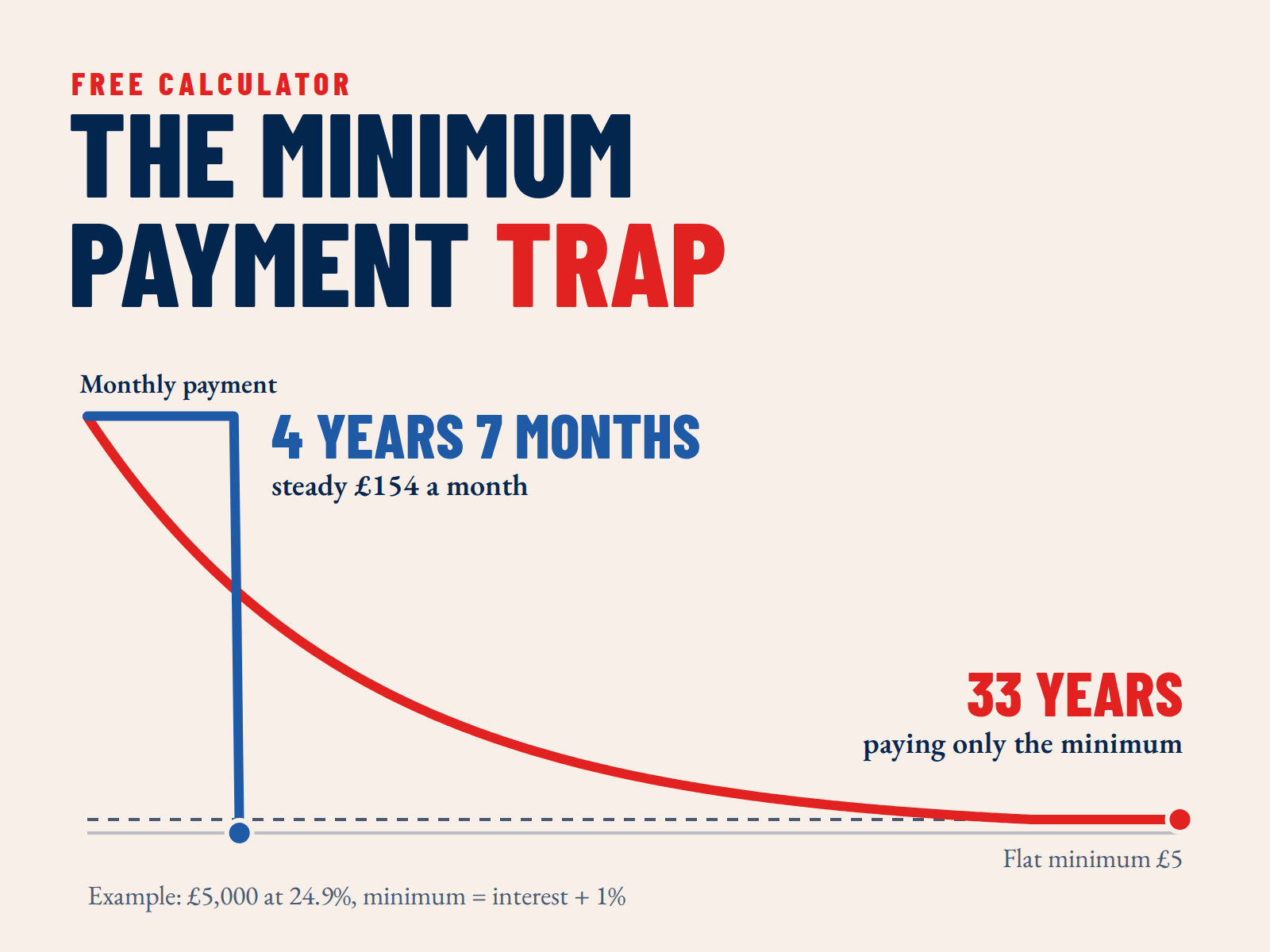
Try the free Minimum Payment Trap calculator
Every debt has three real costs: the price of what you bought, the interest you pay, and the lost opportunity of what that money could have built.
How to find out where you really stand
You can only judge your debt once you can see all of it. That's what the Debt Truth Inventory is for, the most important exercise in Part 1 of the Break Free Forever book.
A Debt Truth Inventory is a list of every debt you owe with eight facts for each: balance, interest rate, minimum payment, term, special conditions, what you actually pay, why you took it on, and its emotional weight.
Include everything, from store cards and buy-now-pay-later to money owed to family. Then total three numbers: what you owe, your minimum payments and what you actually pay.
Here's exactly what to know about every debt you owe.
Sarah, from the book, had paid minimums on three cards for six years, telling herself she was "managing it." Her inventory showed £18,400 of debt, and she'd been on track to pay back nearly £40,000. She called it "a cold shower I didn't know I needed." Within eighteen months, she was debt free.
Is your debt manageable? A traffic-light check
Count how many of the 10 warning signs apply to you. The answer shows how urgently to act and whether to bring in free help.
| Where you are | What it usually means |
|---|---|
| Green 0 to 1 signs, under the 15% line |
Manageable. A clear plan will clear it faster and save interest. |
| Amber 2 to 3 signs, or over the 15% line |
Stretching you. Stop adding to it and start a structured plan. |
| Red 4 or more signs, or sign 6 or 7 |
Unmanageable. Protect your priority bills and speak to a free debt adviser first. |
What to do when your debt is unmanageable
When debt is unmanageable, stop it growing, protect your essentials, then build a plan, in that order.
1. Stop avoiding it, and drop the shame
Avoidance doesn't protect you from debt. It protects debt from you. Let go of the shame, too: it stops people asking for help when they could turn things around. If your debt built up during a job loss, a separation or illness, that's what the book calls Survival Debt. The debt is evidence of that survival, not evidence of failure.
2. Put down the shovel
You can't get out of debt with more debt. Just as you can't drink your way out of a drinking problem, you can't debt your way out of a debt problem. That includes consolidation loans: they can have a role later, but they move the debt without changing the habits behind it. Read why consolidated debt is still debt.
3. Protect your priority bills and talk to the people you owe
In the UK, StepChange lists priority debts as including rent or mortgage, council tax, energy, water, court fines and child maintenance. Missing them can cost you your home or your supply, so keep them paid where you can. If you're struggling with repayments, tell the people you owe before payments are missed.
4. Get free help if you're in the red
If your light is red, speak to a free debt adviser. They can talk to your lenders and may be able to freeze interest or set up affordable payment plans. That's what happened for Jody: "I got help from a debt charity who wrote to the banks, froze the interest, and put me on payment plans." Today she says, "I am debt free. I'm no longer blacklisted. My credit score is restored."
Don't stay trapped to protect your credit score. A score can be rebuilt; years lost to debt are much harder to get back. Here's how to check your credit score and why it matters.
5. Put a structured plan in place
Next comes the plan. Mine is the Debt BLITZ: The Wealth Chef's get-out-of-debt method from Ann's Break Free Forever book: Bring it into the light, Lock the leaks, Identify your target, Turbocharge the fuel, Zero it and roll. The debt snowball is used inside it.
Before you start, build an Emergency Pot: about £800, $1,000, €1,000 or R10,000 in a separate account, built before the BLITZ, so a surprise bill never sends you back to credit. Then automate the plan. To choose which debt goes first, see debt snowball vs avalanche, and why the BLITZ hybrid method beats both.
6. Focus on your freedom, and say it out loud
Make your freedom more important than things, and be loud and proud: you're claiming your life back.
Phumulela and Ntobeko, both in great jobs, were caught in the "this is what success looks like" trap, with a R2.8 million debt hole. After putting their BLITZ plan in place, they cleared R1.8 million in one year. Watch Phumulela and Ntobeko tell their story.
Where to get free debt help in the UK, US and South Africa
Free, confidential debt advice exists in all three countries, so you should never need to pay for it.
| Country | Where to get free help |
|---|---|
| UK | StepChange, National Debtline or MoneyHelper's debt advice locator. MoneyHelper: help if you're struggling with debt |
| US | A non-profit credit counselling agency that's a member of the NFCC or the FCAA, or on the Department of Justice's approved list. Be wary of anyone who pushes a debt management plan as your only option. CFPB: what is credit counselling? |
| South Africa | An NCR-registered debt counsellor, through debt review under the National Credit Act. Ask for the full cost in writing before you sign. You can't take on new credit while under debt review, and interest doesn't stop. NCR: 011 554 2700 |
Questions people ask
How much debt is too much?
Any consumer debt you can't clear from your income without borrowing more is too much. My quick check is the 15% line above.
Will getting debt help ruin my credit score?
Some debt solutions do show on your credit file for a time. In South Africa, debt review adds a debt counselling indicator to your profile, which the National Credit Regulator says is not blacklisting. A credit score can be rebuilt.
See your debt clearly, free, with ZARA
ZARA, my free AI debt assistant, builds your Debt Truth Inventory with you, sets your BLITZ order and freedom date, and shows what each extra pound a month buys you in time and interest saved. Save your results with your email.
Build your Debt Truth Inventory free with ZARA
The whole plan, from facing the numbers to staying out for good, is in the Break Free Forever book, with worksheets, digital assistants and a video masterclass.
If you're in serious financial difficulty, you don't have to work it out alone. Free, confidential help is available from StepChange, MoneyHelper or National Debtline in the UK, an NFCC-member non-profit credit counsellor in the US, or an NCR-registered debt counsellor in South Africa.
This article is for education only and isn't financial advice.
Written by Ann Wilson, founder of The Wealth Chef and author of The Wealth Chef and Break Free Forever. Debt-free since 1994 and financially free since 2006.