The Minimum Payment Trap: How Long It Really Takes to Pay Off a Credit Card
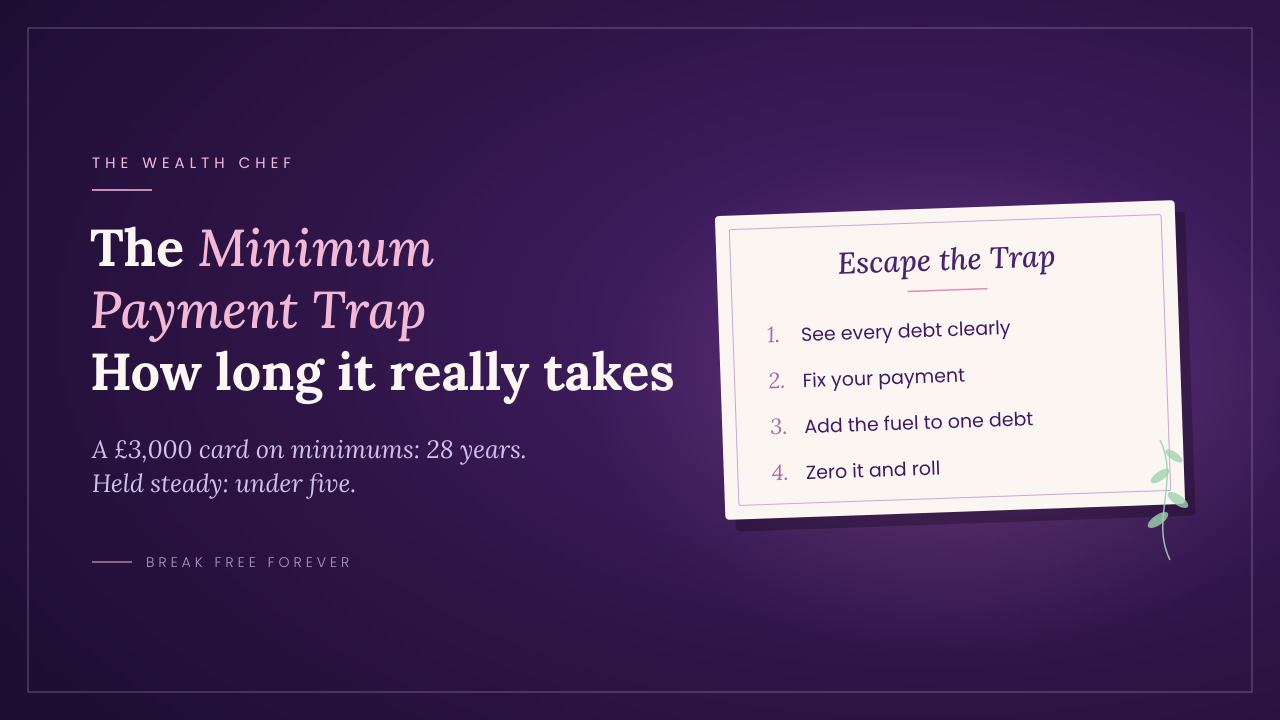
If you only ever pay the minimum on a credit card, a modest balance can take decades to clear. In my Break Free Forever book, a £3,000 card at 21% takes 28 years and costs £5,042 in interest on minimums alone. That's the Minimum Payment Trap: minimum payments are set as a small slice of what you owe, so they shrink as your balance shrinks and barely reduce the debt. The way out is to stop letting your payment shrink. Hold it fixed, or raise it, and the same card clears in under five years.
This guide is part of my complete guide to getting out of debt and staying out.
Minimums feel safe and sensible. Here's what they actually do, with real numbers, and how to climb out.
How does the Minimum Payment Trap work?
The Minimum Payment Trap works because your minimum is worked out as a fraction of what you still owe. As the balance falls, the payment falls with it, so the finish line keeps moving away from you.
Most major credit cards set the minimum at that month's interest plus 1% of the balance. On a £3,000 card at 21%, your first minimum is about £82. About £52 of that is interest. Only about £30 comes off what you owe.
Next month you owe a little less, so the minimum is a little smaller, so even less comes off. It feels responsible. It's designed to keep you paying for as long as possible.
Your trap might be worse
Some card issuers use a flat percentage of the balance instead, often 2%. On £3,000 that's £60 a month, and at 21% interest only about £8 of it reduces the debt.
That's what happened to Jody, whose story is in the book. "One card had a £5,000 balance. I was paying the £80 minimum every month, and only £5 of it was coming off the actual debt. The other £75 was interest. I worked out it would take me thirty-four years to clear that one card at the minimum. And that was ONE card."
Want to see it on your own numbers? Put one card, store account or loan into my free calculator and see how long the minimum really takes.
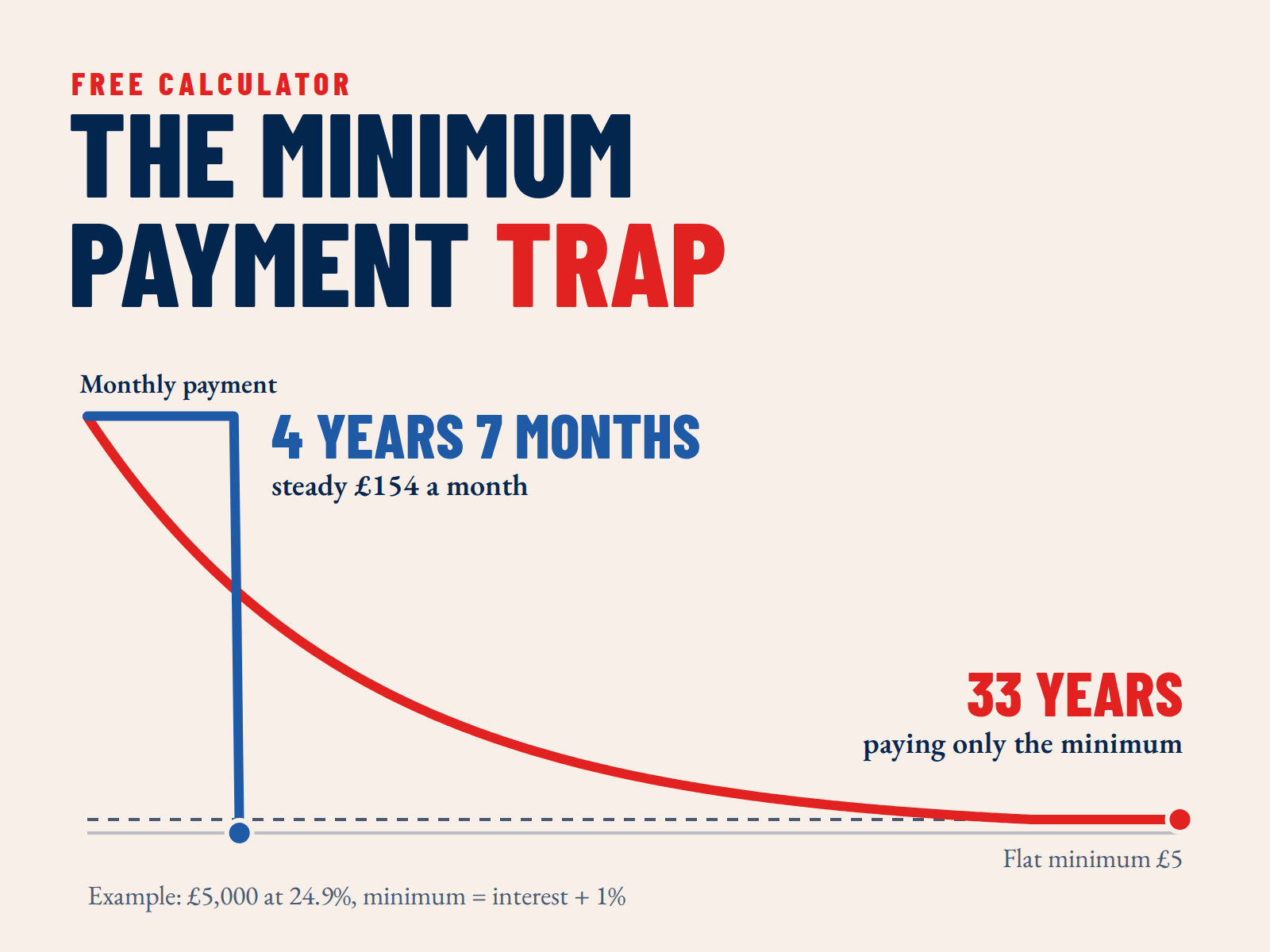
Try the free Minimum Payment Trap calculator
How long does it really take to pay off a credit card on minimums?
On minimum payments alone, a £3,000 card at 21% takes 28 years to pay off and costs more than £8,000 in total. Keep the payment fixed at the first minimum and it clears in 4 years and 10 months.
Here is the same card, followed to the end three ways. These are the worked examples from chapter 8 of the book, with no new spending added.
| How you pay the £3,000 card at 21% | What it costs you |
|---|---|
| The shrinking minimum (interest plus 1%, starting at £82.50) |
28 years to clear £5,042 in interest Over £8,000 in total |
| A fixed £82.50 a month (the first minimum, held steady) |
4 years 10 months to clear £1,810 in interest £4,810 in total |
| A fixed £120 a month (£37.50 more than the first minimum) |
2 years 10 months to clear £980 in interest £3,980 in total |
Look at the middle row. Same payment you started with. The only change is refusing to let the bank ratchet it down. That one decision saves £3,232 and more than 23 years of your life.
The pattern is the same in dollars, euros or rand, because it's the arithmetic of a shrinking payment, not a feature of one currency. The higher the rate, the deeper the trap. In chapter 11 of the book, a £4,500 card at 27% with a 3% shrinking minimum takes 29 years and 6 months to clear, with £12,435 of interest.
Why do the numbers look impossible?
The numbers look impossible because you never see them play out. Most of us keep adding to the card, so the balance and the minimum change every month, and the true timeline stays hidden.
Nobody buys one thing on a card, pays the minimum for 28 years and buys nothing else. But that hidden timeline sits underneath every revolving balance. A moving target means you never see what any single purchase is really costing you.
I once worked with a woman I'll call Sarah. She had paid the minimums on three credit cards for six years and told herself she was managing it. When she did the sums, she owed £18,400 and was on track to pay back nearly £40,000 for things she'd mostly forgotten buying. She called it "a cold shower I didn't know I needed." Within eighteen months, she was debt-free.
The three real costs of a minimum payment
Every minimum payment carries three real costs: the price of what you bought, the interest you pay, and the lost opportunity of what that money could have built. Most people only ever see the first.
| Cost | On the £3,000 card |
|---|---|
| 1. The price of the thing | £3,000, for things you may not even remember |
| 2. The interest | £5,042 on the shrinking minimum, well over the price itself |
| 3. The lost opportunity | Money that could have been compounding for you instead of against you |
The third cost is the one nobody talks about. In the book's example, £200 a month invested at an assumed 10% a year grows to about £41,000 after 10 years, £152,000 after 20 and £452,000 after 30. That's an illustration, not a promise, but it shows what debt payments can stop your future self from having.
The Break Free Forever book walks you through all three costs on your own debts, so you see your own numbers, not mine.
What your lender has to tell you
In the UK and the US, lenders must give you some warning about the cost of minimum payments. Few people read it, and it rarely shows the full picture of the three costs.
| Where you live | What to know |
|---|---|
| UK | The minimum must at least cover the interest, fees and charges, plus 1% of the balance. If you pay more in interest and charges than you repay over 18 months, you're in persistent debt and your provider must contact you. MoneyHelper explains persistent debt. |
| US | Your statement must show how long it would take to pay off the balance with minimum payments only, and how much a month would clear it in 36 months. The CFPB explains the statement box. |
| South Africa and elsewhere | Find your minimum payment rule and interest rate on your statement or card terms, and ask your provider for the payoff figures. You can run them in any debt calculator. |
Wherever you live, you can ask your provider how long the balance will take on minimums and what it will cost in total.
How to escape the Minimum Payment Trap
You escape the Minimum Payment Trap by seeing every debt clearly, fixing your payments so they stop shrinking, and putting extra money at one debt at a time. That's the heart of the Debt BLITZ, The Wealth Chef's get-out-of-debt method from my Break Free Forever book: Bring it into the light, Lock the leaks, Identify your target, Turbocharge the fuel, Zero it and roll. The debt snowball is used inside it.
1. Bring it into the light
Start with your Debt Truth Inventory: a list of every debt you owe with eight facts for each: balance, interest rate, minimum payment, term, special conditions, what you actually pay, why you took it on, and its emotional weight. Here's how to do your Debt Truth Inventory.
2. Fix your payments
Note this month's minimum on each debt and set a fixed payment at that amount or higher. Then keep paying it, even as the bank's minimum falls.
3. Add fuel to one target
Your Debt Destroyer Fuel is the extra money each month, on top of all minimum payments, that goes to one priority debt at a time. Every other debt keeps its fixed payment. When the target hits zero, its whole payment rolls onto the next one. Here's the Debt BLITZ Method step by step.
4. Ask your future self
Before you add anything new to a card, ask: would my future self agree to pay for this, at full cost, given everything she knows? Not the easy monthly version. The price, the interest and what she'll go without.
Questions people ask
Is it bad to only pay the minimum on a credit card?
Paying the minimum keeps your account in good standing, but it's the slowest and most expensive way to clear the balance. On the book's £3,000 example, it means 28 years and £5,042 of interest.
How long does it take to pay off £5,000 on minimum payments?
It depends on your rate and how your minimum is worked out. For Jody, an £80 minimum on a £5,000 card meant about thirty-four years. Your statement, your provider or a debt calculator can give you your own figure.
Does paying more than the minimum help?
Yes. Even holding your payment at the first minimum instead of letting it shrink cut the £3,000 example from 28 years to under five. Paying £37.50 more a month cut it to under three.
Get out of the Minimum Payment Trap for good
The Break Free Forever book is where you do this properly. It follows the £3,000 card all the way to the end, shows you the full Debt BLITZ step by step, and works on the emotional patterns that keep the cards coming back, so you get out and stay out. It comes with book-owner resources, including the debt calculator, digital assistants and a video masterclass.
Get the Break Free Forever book
Already have the book? Get your free Break Free Forever resources.
Not ready for the book yet? ZARA is my free AI debt assistant. She builds your Debt Truth Inventory with you, sets your BLITZ order and freedom date, and shows you what each extra pound a month buys in time and interest saved. Save your plan with your email at the end.

Build your BLITZ plan free with ZARA
If you're in serious financial difficulty, you don't have to work it out alone. Free, confidential help is available from StepChange, MoneyHelper or National Debtline in the UK, an NFCC-member non-profit credit counsellor in the US, or an NCR-registered debt counsellor in South Africa.
This article is for education only and isn't financial advice.
Written by Ann Wilson, founder of The Wealth Chef and author of The Wealth Chef and Break Free Forever. Debt-free since 1994 and financially free since 2006.