What Is a Good Expense Ratio? How Fees Eat Your Returns
A good expense ratio for an index fund is 0.25% or less for a broad market tracker, and 0.5% is the ceiling I set in The Wealth Chef book. The expense ratio is the fund's yearly charge, called the ongoing charges figure (OCF) in the UK and the total expense ratio (TER) in South Africa. Then add your platform and adviser fees, because the number that matters is your all-in cost. Keep that well under 1% a year.
This guide is part of my complete guide to investing in index funds.
Cost is the first of my 3 C's of investing success: cost, consistency and contributions. You can't control the markets. You can control what you pay.
What is an expense ratio?
An expense ratio is the yearly cost of running a fund, shown as a percentage of the money you have in it. On an expense ratio of 0.25%, you pay £2.50 a year for every £1,000 invested.
You never get a bill. As I tell my members, the charge is absorbed inside the fund, so it comes out of your returns rather than your bank account. That's why so many people have no idea what they're paying.
It's also why the percentage feels harmless. In the UK, the Which? guide to fund charges explains that the OCF is the annual management charge plus extras that can add around 0.1%. Trading costs and performance fees aren't included in it.
What is a good expense ratio for an index fund?
For a broad market index tracker, 0.25% or less is good, and 0.5% is the most I'd pay. Anything above 1% is expensive for a fund that simply follows an index. Here's how I read the numbers.
| Yearly fund charge | How I read it |
|---|---|
| 0.25% or less | Good. This is what a low-cost broad market tracker should cost. |
| 0.25% to 0.5% | Fine. Often normal for narrower slices such as emerging markets, global property or a smaller home market. Check for a cheaper tracker of the same index. |
| 0.5% to 1% | Ask why. In The Wealth Chef book I say to select a fund with a TER of 0.5% or less. What are you getting for the extra? |
| Above 1% | Expensive for tracking an index. You're likely in an actively managed fund, or a tracker with a costly wrapper. |
These bands are my teaching guide, not a rule of nature. They fit what the market charges. Which? puts annual management charges at 0.01% to 0.85% for most trackers and ETFs, and 0.75% to 1.25% for most active funds. In the US, Morningstar’s 2026 fund fee study found the asset-weighted average was 0.32% across all funds in 2025, with broad index funds at 0.09% and active funds at 0.57%.
Compare like with like. A global property tracker will often cost more than an S&P 500 tracker, and that's fine as long as it's competitive for what it holds.
How fees eat your returns
Fees eat your returns twice: they take the money itself, and everything that money would have grown into. If your investments return 7% a year, a 1% cost takes about one-seventh of your growth, every year, for as long as you stay invested.
Say you invest £300 a month for 25 years, and the market returns 7% a year before costs in every case. You pay in £90,000 each time. This is an illustration of how costs compound, not a prediction or a recommendation.
| Total yearly cost | Value after 25 years | Lost compared with 0.25% |
|---|---|---|
| 0.1% | About £232,800 | You gain about £5,100 |
| 0.25% | About £227,600 | Nothing |
| 0.5% | About £219,400 | About £8,300 |
| 1% | About £203,900 | About £23,800 |
| 1.5% | About £189,600 | About £38,000 |
| 3% | About £153,200 | About £74,500 |
The percentages work the same in dollars, euros or rand. The US regulator shows the same pattern in its investor bulletin on fees: $100,000 growing at 4% a year for 20 years ends at about $208,000 with a 0.25% fee, and about $179,000 with a 1% fee.
Two lessons sit in that table. Moving from 3% to under 1% is life-changing. Moving from 0.25% to 0.1% is pleasant, but it isn't worth losing sleep over, or paying exit fees for. As I tell my members, don't get bogged down. Get the big number right, then get on with investing.
Morningstar's research backs this up: it calls fees a reliable predictor of future returns, because low-cost funds generally have better odds of surviving and outperforming pricier peers. That's a big reason index funds beat most actively managed funds.
The expense ratio is only one layer of your costs
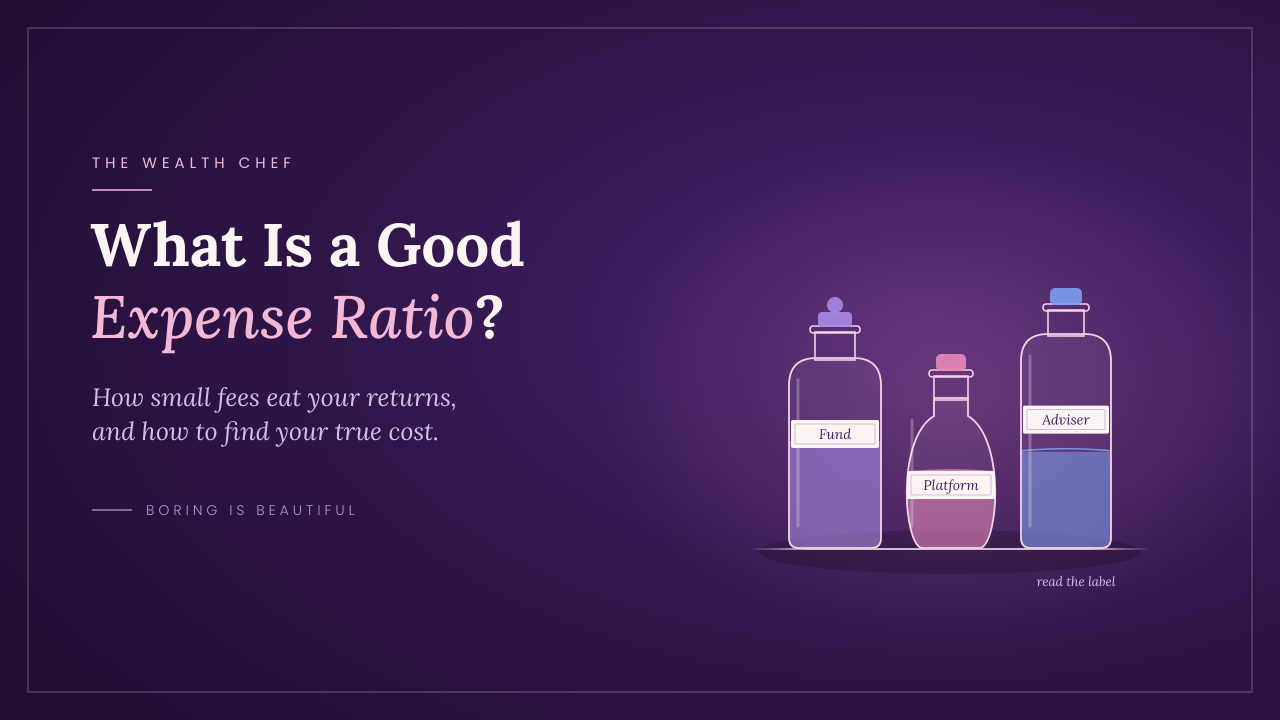
Your true cost has three layers: the fund, the platform and the adviser. A cheap fund on an expensive platform with a percentage adviser fee on top isn't a cheap investment. My rule is to keep all three together well under 1% a year.
| Layer | What it is | Where to find it |
|---|---|---|
| 1. The fund | The expense ratio, OCF or TER | The fund fact sheet |
| 2. The platform | Yearly fees for holding your investments, plus any admin fee for pension or tax-free accounts, and dealing fees to buy and sell ETFs | The platform’s charges page |
| 3. The adviser | An upfront or yearly fee, often a percentage of your whole pot | Your adviser agreement or yearly costs statement |
Watch for fees hiding inside fees
Be wary of funds of funds, the ones with grand, reassuring names. They bundle several funds together, so a headline charge of, say, 0.75% may not include the fees inside each underlying fund. I call this the WISIWYG test: what's inside is what you get. Read the label.
One member sent me a fact sheet showing a TER of 1.96%, plus a 1.1% annual fee. Here's how that compares with a simple tracker set-up (the tracker column is an illustration).
| Cost | Simple tracker set-up | The member’s fund |
|---|---|---|
| Fund charge | 0.2% | 1.96% |
| Yearly fee on top | 0.25% | 1.1% |
| All-in cost | 0.45% | 3.06%, before transaction costs |
That's nearly seven times the cost. On a 7% return, more than 40% of the growth goes on charges. Yet both can hold shares in the same companies.
I've seen how much this matters. Julie, who runs bespoke travel experiences in Portugal, was investing but watching fees devour her small profits, until she took control of her portfolio. You can read Julie’s story here.
How to find your all-in cost in five steps
You can work out your all-in cost with a statement, a fact sheet and a calculator. It takes about as long as a cup of tea.
- List every investment in every account: pension, tax-free and discretionary.
- Open each fund fact sheet and write down the expense ratio, OCF or TER.
- Add the platform fee. If it's a flat fee, divide it by your balance. A £72 yearly fee on £12,000 is 0.6%.
- Add any adviser fee. If you can't find it, ask for it in writing.
- Add it up. If it's over 1%, ask what you're getting for it.
Before you move anything, check for exit fees, lost guarantees and tax on gains outside tax-free accounts. Often the simplest first step is to point new contributions at low-cost trackers. If you work with an adviser, my guide on how to choose a financial advisor who puts you first covers the questions to ask.
Watch dealing fees on small amounts, too. In The Wealth Chef book I suggest keeping each trade under 1% of what you invest. A £5 fee on a £100 purchase is 5%, but on £500 it's 1%. This is one reason small monthly amounts can suit unit trust or mutual fund trackers.
What to look for where you live
Every country uses different names for the same thing, so look for the fund's yearly charge first, then the costs around it.
| Where | Look for | Worth knowing |
|---|---|---|
| UK | OCF on the fund fact sheet, plus your platform fee | The OCF leaves out trading costs and performance fees |
| US | Expense ratio in the prospectus or fact sheet, plus any advisory fee | Sales charges on some mutual funds are separate |
| South Africa | TER, total investment charge (TIC) and effective annual cost (EAC) | TIC is the TER plus transaction costs. EAC adds platform and adviser fees, so it’s the fullest figure to compare |
| Europe and living abroad | Ongoing charges on the fund’s key information document | Expat savings plans and offshore bonds can stack several charges. Ask for every one in writing |
In South Africa, this Mail & Guardian guide explains how the measures fit together, and Profile’s Unit Trusts guide sets out how the TER and EAC are defined.
Questions people ask
Is 0.5% a high expense ratio?
For a broad market index tracker, yes, it's on the high side, because 0.25% or less is widely available in most markets. For a narrower tracker it can be reasonable. It's still the top of the range I'd accept.
Do you pay the expense ratio out of your account?
No. It's taken inside the fund, so you'll never see it as a line on your statement. It shows up as a slightly lower return, which is exactly why it's so easy to ignore.
Is the cheapest index fund always the best?
Usually, among funds tracking the same index, but check that it tracks the right index, is an accumulation or income fund as you want, and is available on your platform. Don't choose on recent performance. Funds tracking the same index should get the same market return, give or take costs. Boring is beautiful.
See how I choose low-cost trackers
If you'd like to see exactly how I check costs, choose my index trackers and build a portfolio that runs on autopilot, join my free How to Be a Successful Investor masterclass. It's a 90-minute training, and I walk you through the whole recipe, built on my KISS core investing strategy (keep it simple, sexy and safe).

Register for the free How to Become a Successful Investor masterclass
When you're ready to build yours with me, step by step, my Savvy Investor programme takes you from opening your platform to a fully designed, automated index tracker portfolio. You'll hear all about it in the masterclass.
This article is for education only and isn't financial advice.
Written by Ann Wilson, founder of The Wealth Chef and author of The Wealth Chef and Break Free Forever. Debt-free since 1994 and financially free since 2006.