Save to Spend: How to Stop Christmas Putting You Back in Debt
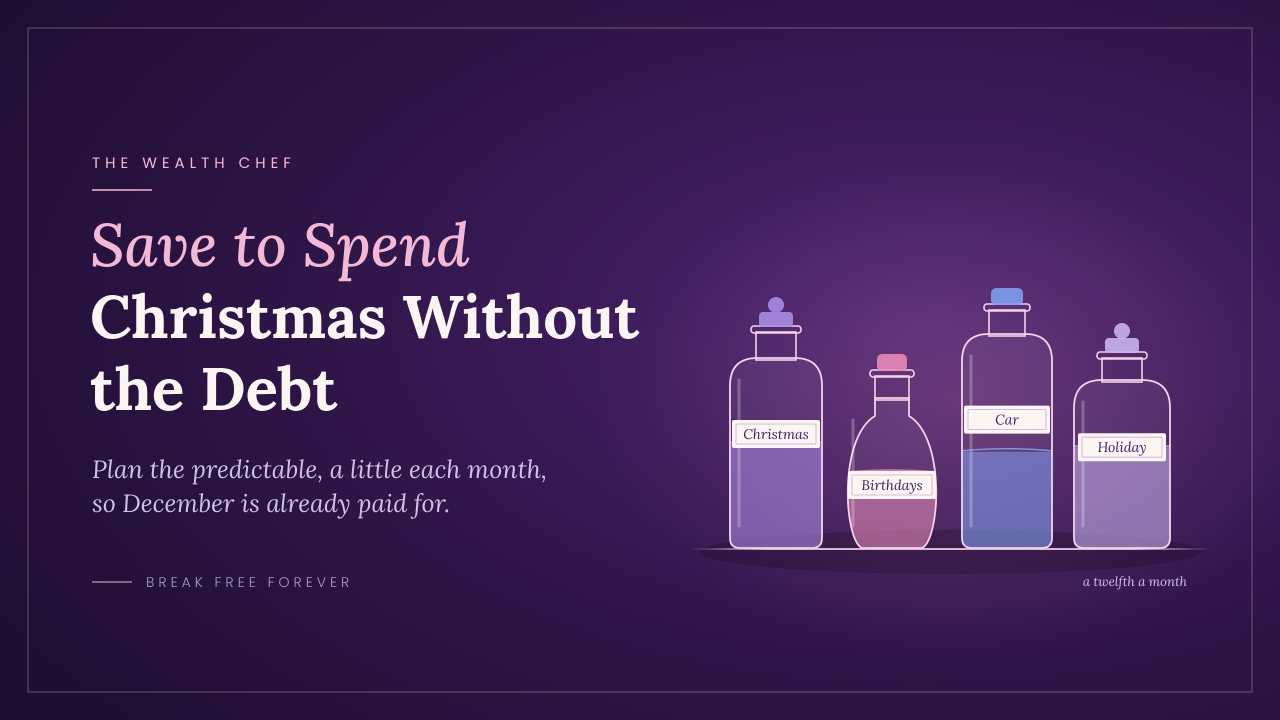
The way to stop Christmas putting you back in debt is to stop treating it as a surprise. In my Break Free Forever book I call the fix Save to Spend: adding up the costs you know are coming in the next 12 months, dividing by 12, and setting that amount aside every month. A £600 Christmas becomes £50 a month from January. By December it's already paid for, so nothing goes on the card and your debt plan keeps moving.
This guide is part of my complete guide to getting out of debt and staying out.
Remember this: an emergency is something you couldn't see coming. Christmas happens every year, on the same date, and you've known about it your whole life. It's never late.
Why does Christmas put people back in debt?
Christmas puts people back in debt because it arrives with no plan behind it, so it gets paid for the way an emergency would be: out of whatever's left, or on credit. That isn't bad luck. It's a planning gap.
If you're running your Debt BLITZ, December is when a lot of plans stall. Either the extra payments pause, or the card comes out. Both undo months of hard work. The Debt BLITZ is The Wealth Chef's get-out-of-debt method from my Break Free Forever book: Bring it into the light, Lock the leaks, Identify your target, Turbocharge the fuel, Zero it and roll. The debt snowball is used inside it. Here's the Debt BLITZ step by step.
And it's rarely only Christmas. Birthdays, the car service, school costs and insurance renewals are just as predictable. Christmas is simply the loudest.
What is Save to Spend?
Save to Spend is a separate pot for the costs you can see coming. Every predictable cost that isn't part of your regular monthly spending gets added up for the year and divided by 12, and that monthly amount goes into the pot automatically on payday.
That's the whole system. It doesn't cost you anything extra, because this is money you were always going to spend. You just weren't spending it on purpose, in advance. A surprise is only a cost with a due date you weren't tracking.
Save to Spend is not your Emergency Pot
Mixing the two is one of the most common reasons money plans break. Your Emergency Pot is about £800, $1,000, €1,000 or R10,000 in a separate account, built before the BLITZ, so a surprise bill never sends you back to credit. Christmas isn't a surprise, so it doesn't belong there.
| Emergency Pot | Save to Spend | |
|---|---|---|
| What it's for | Unexpected, unavoidable, urgent | Expected, planned, occasional |
| Examples | A shredded tyre A burst geyser or boiler |
Christmas Car service Holiday School fees |
| How often it's used | Rarely, ideally never | Regularly, by design |
| After you use it | Refill it before anything else | It refills itself each month |
If Christmas comes out of your Emergency Pot, two things go wrong. Your buffer is empty just as winter brings its usual boiler trouble. And you've taught yourself that Christmas is an emergency, which keeps you in the same reactive relationship with money you're working to leave behind. For more on the pot itself, here's how much emergency fund you need while paying off debt.
How do you work out your Save to Spend amount?
List every predictable cost for the next 12 months, put a real annual figure next to each one, divide each by 12 and add up the monthly column. That total is your monthly Save to Spend transfer.
Use your last 12 months of bank statements for real figures. Don't guess. Look. The book's examples:
| Category | Annual cost | Monthly |
|---|---|---|
| Christmas and gifts | £600 | £50 |
| Car service, MOT, tyres | £350 | £29 |
| Annual holiday | £1,200 | £100 |
The maths works the same in dollars, euros or rand: annual cost divided by 12. As a rough guide, the book puts the whole pot at around 10% of gross income, or a twelfth of your annual predictable costs.
Your Save to Spend checklist
Not every category will apply to you, but work through each one:
- Christmas, the festive season and other gift-giving occasions
- Birthdays: family, partner, your own, children's parties
- Car: service, MOT or roadworthy, tyres, licensing
- Annual holiday or travel
- Back-to-school costs: uniforms, supplies, activity fees
- Home maintenance: gutters, painting, replacing appliances
- Dental, optical and other health costs your insurance doesn't cover
- Annual subscriptions you decided to keep
- Pets: vet check-ups, vaccinations, licences
- Professional fees, memberships or licences renewed every year
For the Christmas line itself, think wider than presents. MoneyHelper's Christmas budget list includes the costs people forget: cards and stamps, the tree and lights, wrapping, the food, party clothes, travel to family, and work drinks and New Year's Eve.
Where does the money come from when you're already paying off debt?
The money was always coming from somewhere, because every one of these costs was always going to be paid. The only question is whether it's paid planned and painlessly, or unplanned and usually on credit.
If you can't fund everything yet, follow this order while you're building:
- Minimum payments on every debt. Non-negotiable, always.
- Your Emergency Pot, until it reaches its target.
- Then split what's left between Save to Spend and your Debt Destroyer Fuel: the extra money each month, on top of all minimum payments, that goes to one priority debt at a time.
If you have to choose between a slightly slower BLITZ and a Save to Spend system that stops predictable costs becoming emergencies, Save to Spend wins. It protects your BLITZ from the exact derailments that make people give up.
Even a partial system covering your two or three biggest must-have costs is far better than none. And some of the money may already be there. A Wealth Leak Audit, a check of six places money leaks out without you choosing it (convenience spending, subscriptions, lifestyle creep, emotional spending, social and obligation spending, and bank fees), often frees up enough. Here's how to find extra money to pay off debt.
What if Christmas is only weeks away and you haven't saved?
If Christmas is close and there's no pot, set your Christmas number from the cash you actually have, not the credit you could get. Then start next year's pot in January, so this is the last Christmas that catches you out.
The priority order still applies: minimums first, Emergency Pot untouched. What's left is your Christmas budget, and it may be smaller than you'd like. That's where the real choices get made: what you truly want, who you're buying for, and what you're doing out of obligation.
In South Africa, the National Credit Regulator's festive season guidance makes the same point: draw up a festive budget and shopping list, pay necessities before luxuries, and "if you don't have cash for it, you don't need it."
And when the presents are open, don't hand January's money to the sales. Here's why I'm never in the queue: beat the Boxing Day blues.
How should you set up a Save to Spend account?
Keep Save to Spend money visibly separate from your everyday account, with one automatic transfer on payday. Separation and automation matter far more than the exact structure.
- Simplest: one Save to Spend account and one payday transfer for the total.
- If your bank offers pots or sub-accounts: a named pot for each category. Seeing "Christmas: £350 saved" in November feels very good.
- If it doesn't: one account and a simple spreadsheet tracking each category's running total.
This pot is meant to empty. When you spend your Christmas money in December, the system has worked perfectly, and it starts refilling in January. If a category always has money left over, lower it and send the difference to your BLITZ. If it always runs short, raise it, or get curious about why.
And one rule keeps it working: if a predictable cost ever catches you off guard, add it to the list straight away. It only gets to surprise you once.
What Becky did with hers
Becky's story is in the book. Here's what she shared: "Exactly one year in and I've paid off ALL my debts, invested in property, silver, and the stock market — and we've just booked an all-inclusive trip to Costa Rica, paid for upfront with the proceeds of our 'Save to Spend' pot."
Not a joyless December. The big, lovely things, paid for before they arrive.
Questions people ask
How much should I save each month for Christmas?
Take what last Christmas really cost, from your statements, and divide it by 12. A £600 Christmas is £50 a month. If you're starting later in the year, divide by the months you have left, and keep the total to what that allows.
Is it a bad idea to put Christmas on a credit card?
If you can clear the full balance when the statement arrives, a card is just a way to pay. If you can't, Christmas becomes debt that keeps costing you interest long after the decorations come down, and it slows every other part of your plan.
What's the difference between Save to Spend and a sinking fund?
They work on the same idea: saving a little each month for a known future cost. Save to Spend is the version inside the Debt BLITZ, with its own place in the priority order, kept separate from your Emergency Pot so Christmas never empties your buffer.
Plan this Christmas, then plan your freedom
If Christmas debt has caught you before, the next step is seeing exactly what you owe and when you'll be free. ZARA, my free AI debt assistant, builds your Debt Truth Inventory, sets your BLITZ order and freedom date, and shows what each extra pound a month buys. Save your results with your email at the end.

Build your BLITZ plan free with ZARA
The full Save to Spend system, with the Emergency Pot, the priority order and the whole Debt BLITZ, is in chapter 15 of the Break Free Forever book. It would make a rather good present to yourself.
If you're in serious financial difficulty, you don't have to work it out alone. Free, confidential help is available from StepChange, MoneyHelper or National Debtline in the UK, an NFCC-member non-profit credit counsellor in the US, or an NCR-registered debt counsellor in South Africa.
This article is for education only and isn't financial advice.
Written by Ann Wilson, founder of The Wealth Chef and author of The Wealth Chef and Break Free Forever. Debt-free since 1994 and financially free since 2006.