How Much Emergency Fund Do You Need While Paying Off Debt?
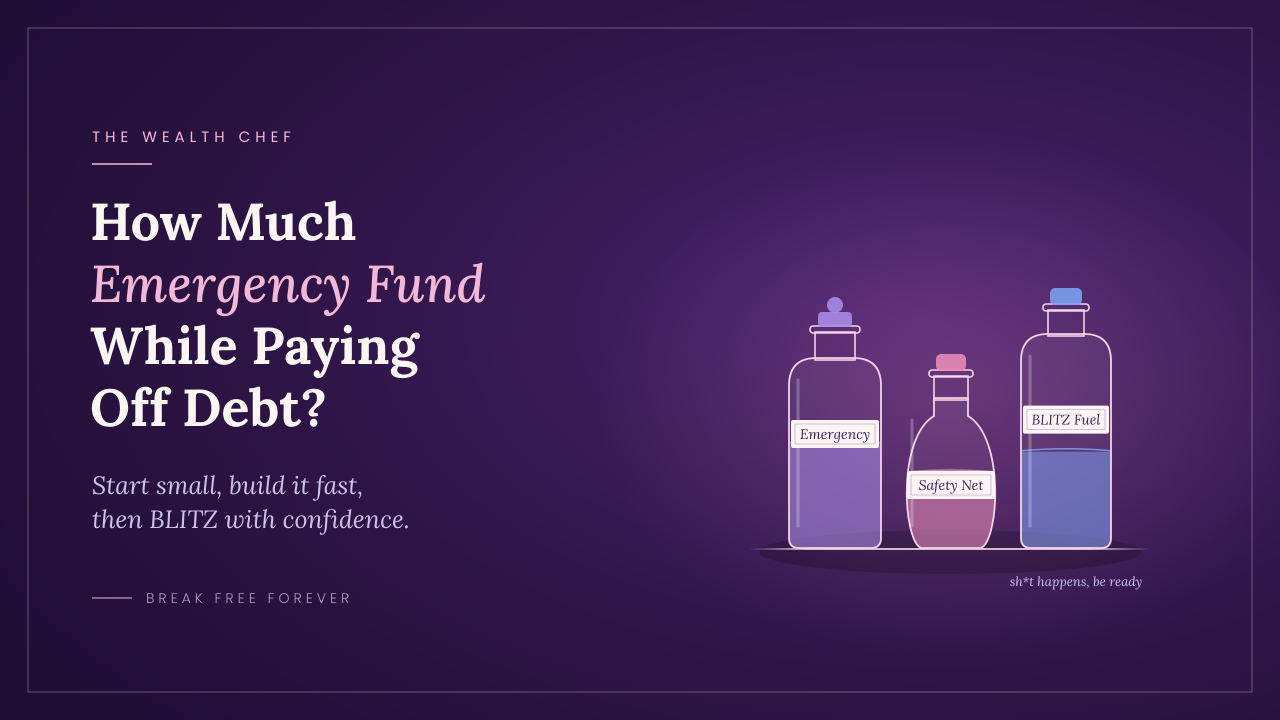
While you're paying off debt, you need a small emergency fund first, not a big one. In my Break Free Forever book I call it the Emergency Pot: about £800, $1,000, €1,000 or R10,000 in a separate account, built before the BLITZ, so a surprise bill never sends you back to credit. Build it fast, then put everything extra into your debt. The full three to nine months of essential costs comes later, built alongside your BLITZ rather than before it.
This guide is part of my complete guide to getting out of debt and staying out.
I've watched people go round the same loop for years. Progress, then something breaks, it goes on the card, and they start again. A small pot of cash breaks that loop.
How much emergency fund do you need while paying off debt?
While you're clearing consumer debt, your emergency fund target is around £800, $1,000, €1,000 or R10,000, depending on where you live. That's enough to cover the most common surprises without touching your debt plan.
It's a small, specific, achievable buffer with one job: when something goes wrong, you don't have to borrow to deal with it. Keep it apart from your savings, your holiday money and your Christmas fund.
Most standard advice gives a bigger number. MoneyHelper suggests three to six months' essential outgoings in instant access savings, and says it's usually cheaper to clear expensive debts like credit cards first. The Emergency Pot does both in the right order: a small buffer now, the full safety net later.
| Stage | How much | When |
|---|---|---|
| Emergency Pot | £800 $1,000 €1,000 R10,000 |
First, before the BLITZ. Every spare amount goes here until it's full. |
| Cash Safety Net | Three to nine months of basic and essential living costs | Built alongside your BLITZ, with a small slice of your savings each month, using the Emergency Pot as the seed. |
Why build an emergency fund before paying off debt?
You build the Emergency Pot first because without it, your debt plan is structurally fragile. One unexpected bill, and there will be at least one, sends you straight back to the credit card and undoes months of progress.
Saving can feel like going sideways, but the emotional cost of a setback is often worse than the financial one.
Even a beautifully built life has emergencies. While I was in Europe, a stone chip from a lawnmower shattered a glass door at our home in the Kruger. It had to be fixed within hours, or the next visitor could have been a baboon. Not a crisis, but it needed paying for immediately. That's what the Emergency Pot is for.
What Jody's story shows
Jody, whose story is in the book, had over £18,000 of debt after a separation and a redundancy. She was living off her redundancy money and watching it shrink. "When I finally paid attention, I was in shock. One card had a £5,000 balance. I was paying the £80 minimum every month — and only £5 of it was coming off the actual debt." She worked out it would take thirty-four years to clear that one card.
"I was down to my last £2,000 of the £26,000, with no idea how I'd survive when it ran out." With no buffer, every surprise had nowhere to go but more debt. She made hard choices, got help from a debt charity and kept going. "Today, I am debt free." Her net worth went from minus £18,000 to £70,000.
That £80 minimum is the Minimum Payment Trap: minimum payments are set as a small slice of what you owe, so they shrink as your balance shrinks and barely reduce the debt. On a £3,000 card at 21%, the first minimum of about £82 includes about £52 of interest, so only about £30 comes off the debt. See how long the minimum really takes, or try your own card, store account or loan in my free calculator.
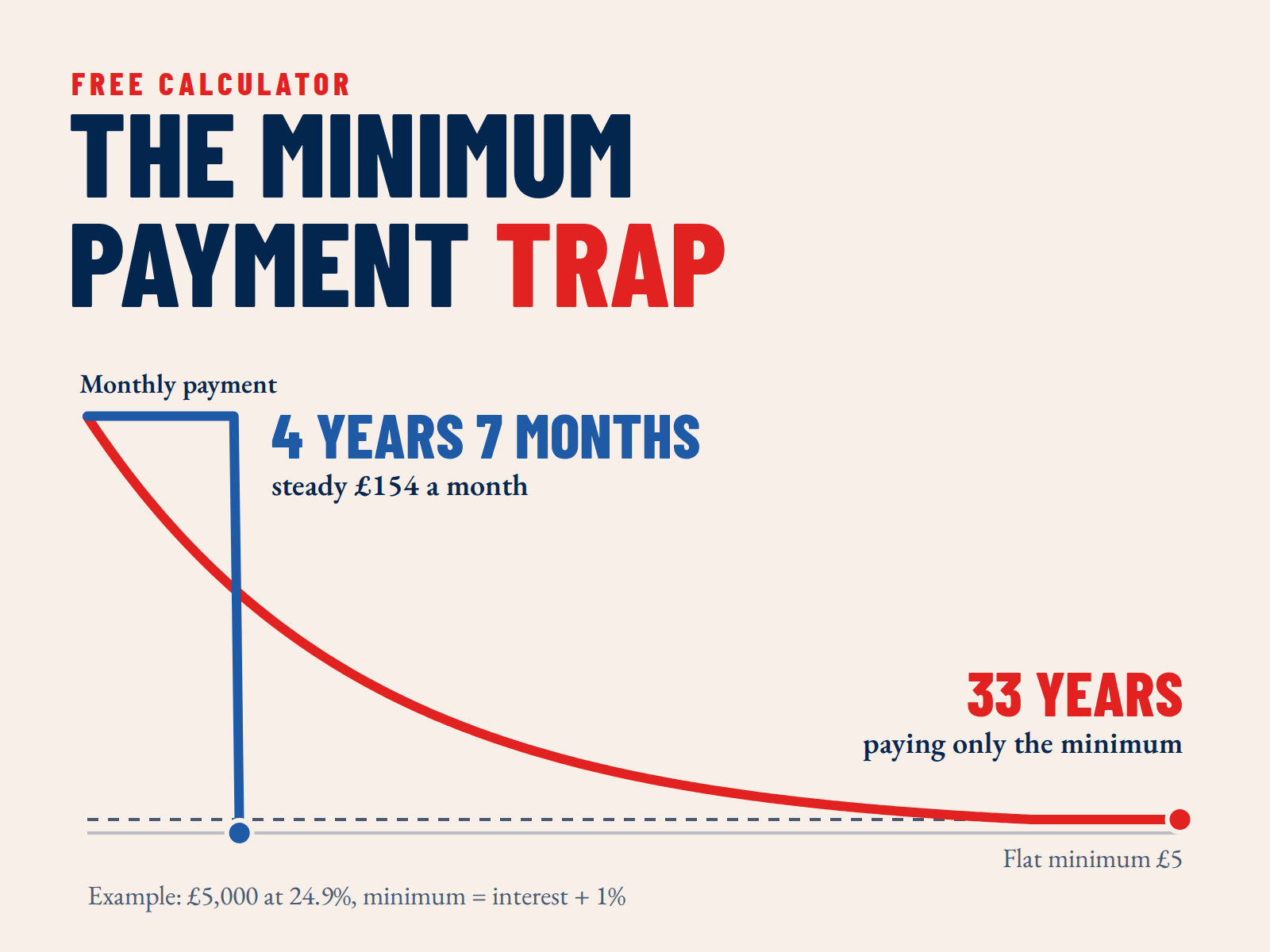
Try the free Minimum Payment Trap calculator
How do you build an emergency fund fast while in debt?
You build it fast by making it your complete focus: a separate account, an automatic payday transfer, and every leak you find redirected into it. For most people that takes four to eight weeks.
- Set your target. Write the number down.
- Open a separate account. Never keep it in your day-to-day account, because money that sits next to your spending gets spent.
- Find the money. Run a Wealth Leak Audit: a check of six places money leaks out without you choosing it: convenience spending, subscriptions, lifestyle creep, emotional spending, social and obligation spending, and bank fees. Here's how to find extra money to pay off debt.
- Automate it. A payday transfer, even a small one, grows without willpower.
- Keep paying every minimum. Don't add to any debt while you build it.
- Stop when it's full. Once the pot hits its target, the money you were putting in becomes extra fuel for your debt.
The frozen card backstop
While you build the pot, put one low-interest credit card in a tin, fill it with water and freeze it. It's there for a real emergency, but defrosting it stops you using it on impulse. The tin means no microwave shortcut. Once your pot is built, you won't need it.
What counts as an emergency?
An emergency is something unexpected, unavoidable and absolutely necessary that would otherwise mean using credit. If you could have seen it coming, it isn't an emergency, and it needs its own plan.
| What it is | Where the money comes from |
|---|---|
| A broken boiler, a car repair, a medical bill, an emergency flight | Your Emergency Pot. Then refill it. |
| Christmas, birthdays, car services, annual subscriptions, back-to-school costs | Save to Spend: adding up the costs you know are coming in the next 12 months, dividing by 12, and setting that amount aside every month. |
| A sale you don't want to miss, an "opportunity" that needs quick action | Nowhere, for now. It isn't an emergency. |
| "I had a terrible week and I need a treat" | The #WTF practice: "Wow, that's fascinating": meeting your money patterns with curiosity instead of shame. |
When in doubt, use the 48-hour rule where you can. If it's still an emergency in 48 hours, use the pot. If it isn't, it wasn't one.
How big should your full Cash Safety Net be?
Your full Cash Safety Net, the cash buffer that makes an emergency an inconvenience, not a crisis, is three to nine months of your basic and essential living costs. Where you sit in that range depends on how secure your income is and how many people rely on you.
Basic costs are food, shelter, security and the ability to earn. Here's a simple example of how the range plays out.
| Your situation | Months to aim for | If essentials cost £1,500 a month |
|---|---|---|
| Stable employment, more than one income in the household | About 3 | £4,500 |
| One income, or some uncertainty at work | About 6 | £9,000 |
| Self-employed, variable income, people who depend on you, or you've lost income suddenly before | Closer to 9 | £13,500 |
Choose the number that lets you sleep easy. In a relationship, the person who needs the biggest safety net wins.
You build this alongside your debt plan, with a small slice of your savings each month. For more, read why you need an emergency fund.
How the advice differs by country
- UK: MoneyHelper's guide points to three to six months of essential outgoings, kept in instant access savings.
- US: in a Consumer Financial Protection Bureau survey, the median amount people said they need for an emergency was $10,000. Your own number depends on your essential costs.
- South Africa: Standard Bank's guidance agrees you don't have to choose between paying off debt and building an emergency fund, and suggests starting with smaller steps towards R10,000.
What if you already have savings?
If you already have savings equal to or more than your Emergency Pot target, you already have the pot. Name it, move it into its own account, and leave it there.
If you have more than the target, debt interest is almost always higher than what your savings earn, so the surplus above your pot can go as a lump sum to your priority debt. With £3,000 saved and an £800 pot, that's £2,200. The Emergency Pot is sacred. Everything else is manoeuvrable.
Once the pot is in place, everything extra becomes Debt Destroyer Fuel: the extra money each month, on top of all minimum payments, that goes to one priority debt at a time. That's where the Debt BLITZ begins. It's The Wealth Chef's get-out-of-debt method from my Break Free Forever book: Bring it into the light, Lock the leaks, Identify your target, Turbocharge the fuel, Zero it and roll. The debt snowball is used inside it. Here's the Debt BLITZ step by step.
Questions people ask
Should I save or pay off debt first?
Do a small amount of both, in order. Build your Emergency Pot first, then put everything extra towards your debt while a small slice keeps growing your Cash Safety Net. Without the pot, the first surprise bill goes back on the card.
Is $1,000 enough for an emergency fund?
As a starter while you're clearing consumer debt, yes. It covers the most common surprises. For the long term, keep building towards three to nine months of essentials alongside your BLITZ.
Should I use my emergency fund to pay off debt?
Not the Emergency Pot itself. Its job is to stop new debt, and spending it on old debt leaves you exposed again. Savings above your target can go to your priority debt.
Protect your progress, then make your plan
Once your pot is in place, ZARA can take you from there. She's my free AI debt assistant: she builds your Debt Truth Inventory, sets your BLITZ order and freedom date, and shows what each extra pound a month buys. Save your results with your email at the end.

Build your BLITZ plan free with ZARA
The Emergency Pot, the frozen card backstop and the full Cash Safety Net are all in chapter 12 of the Break Free Forever book, with the whole Debt BLITZ.
If you're in serious financial difficulty, you don't have to work it out alone. Free, confidential help is available from StepChange, MoneyHelper or National Debtline in the UK, an NFCC-member non-profit credit counsellor in the US, or an NCR-registered debt counsellor in South Africa.
This article is for education only and isn't financial advice.
Written by Ann Wilson, founder of The Wealth Chef and author of The Wealth Chef and Break Free Forever. Debt-free since 1994 and financially free since 2006.